Showing posts with label creature feature. Show all posts

02 October 2009

Bestiary 201: Composite Beasts

For today’s bestiary lesson, we’re going to talk about a few composite creatures – those that seem to be made of the leftovers of Creation.

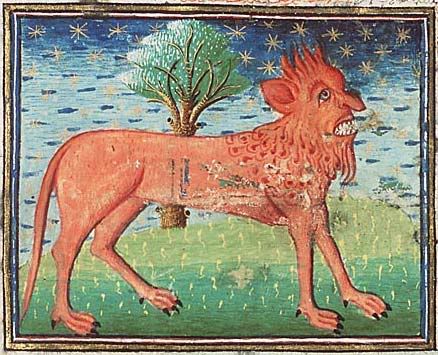
First, the Manticore. The Manticore is made of three elements. It has the face of a man, the blood-red body of a lion, and the tail of a scorpion. It’s from India and feasts on the flesh of men with its rows of sharp teeth. Its voice is that of pipes, or pipes blended with trumpets – somewhat incongruous for such a terrifying beast.
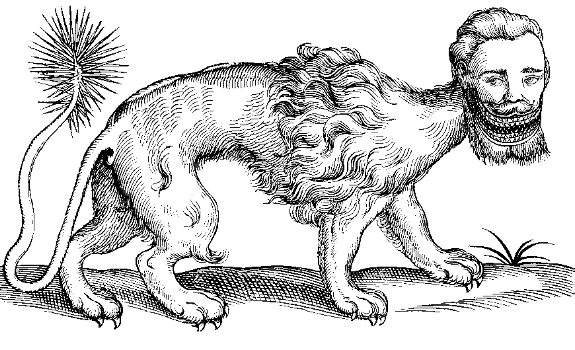
The Manticore, because of its human face, is often related to the Sphinx, even going so far as to make its prey answer riddles. Spiritually, it represents fraud because its face hides its true nature.
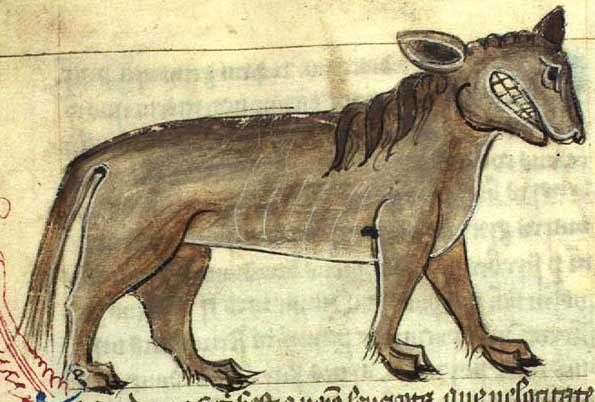
The Leucrota is another impossible combination made from the offspring of a hyena and a lioness. Now, through countless National Geographic Specials, lots of Animal Planet and, of course, “The Lion King,” we know that lions and hyenas do NOT get along, so unless there’s some kind of interspecies Romeo and Juliet thing that happened along the way, plus a good dose of miraculous genetic coding, this particular beast never existed.

Pliny the Elder went even further than hyena/lion in his description: “The leucrocota is the size of an ass, and has the neck, tail and breast of a lion, the haunches of a stag, cloven hooves, a badger's head, and a mouth that opens from ear to ear, with ridges of bone instead of teeth. It is the swiftest of wild animals, and is said to be able to imitate the human voice.”

The next two aren’t so much composite creatures in description, as much as they’re shown that way in illustration.
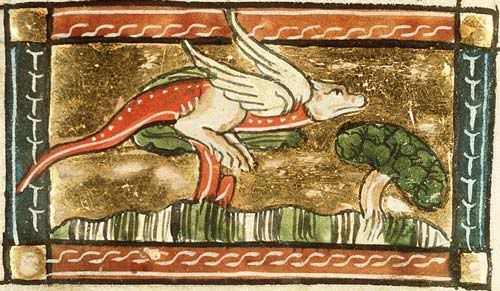

The Jaculus is a flying serpent often depicted with a serpent’s body, but the wings of a bird and the haunches of a beast. It waits in trees for prey to pass beneath, then jumps down and kills it.
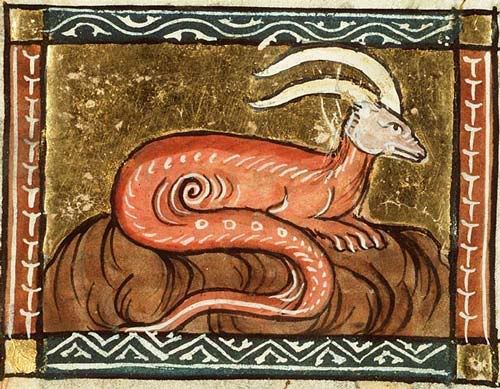
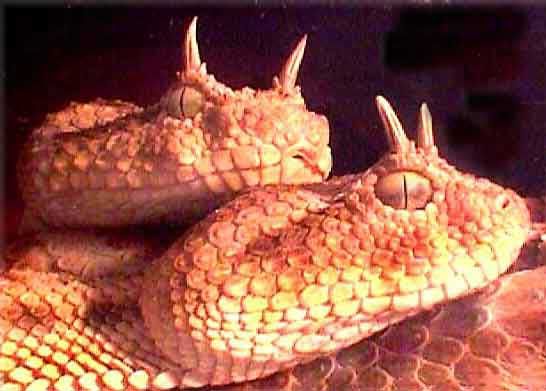
The Cerastes is very likely a Horned Viper, which is a real snake that lives in the Sahara Desert. The medieval illustration, however, depicts a serpent with the literal head of a horned ram.


My bestiary story has been moved back in my writing queue, so there’s no guarantee on what I’ll be talking about next time I blog. I may continue in this vein, I may go back to pantheons of gods – you just never know, so stay tuned!

04 September 2009

Bestiary 102

We're back for another round of fantastic beasts!

First, I'd just like to thank the universe for the wonder known as Inter Library Loan. My library system didn't own a copy of T.H. White's Book of Beasts, so I was able to borrow a copy all the way from the University of Wisconsin! I can't tell you what a happy library geek I am. :)

Today's information will all come from that source as I only have it on loan until next week.

Bestiaries are often divided into sections of beasts, birds and reptiles/amphibians. As I mentioned last time, many of the beasts that are catalogued are real creatures, even if their allegorical traits are a spiritual stretch.

The unicorn is described as being the size of a goat, and may be trapped by a virgin. There's one thing that has always puzzled me about that, though. If a unicorn is a creature of purity and innocence and goodness, and the girl is a willing accomplice in trapping this creature, then how on earth does her physical state of being trump her basic greed and evil? Because you'd have to be a pretty slimy specimen to want to kill a unicorn. You'd think that a mythic beast attracted those wholesome traits would be able to smell the evil intent a mile away.

Oh well, there's a mystery for the ages.

One of the charming things about White's translation are his footnotes. They crack me up. Under the entry for the Griffin, he first quotes Lewis Carroll from Alice in Wonderland: "If you don't know what a Griffin is, look at the picture." He then goes on to theorize that the Griffin has no basis in a real creature, but is an animal of fantasy. He illustrates with a Victorian poem about a mythical Dodo (not the one we know is extinct), but ends with the following statement: "The Griffin, however, was a serious animal.... It does not pay to be supercilious about the creatures in a Bestiary."

Yes, sir.

The section on birds is largely based on real animals with a couple of notable exceptions. First, the Caladrius -- a white bird that could foretell death. If it was shown to a patient who would survive, the bird would face the patient. If, however, it prophesied death, it would turn its head away. Again, White's footnotes add to the story with a uniquely human point of view.

It would be difficult to actually sell a Caladrius to anyone, he writes, because the buyer (presumably the victim of the illness) merely needed to enter the store on the pretense of purchasing the bird, have it look at him and tell his future, then leave the store without actually exchanging cash for the prophecy. White tells us that birdsellers became canny and refused to show the bird unless there was cash in hand.

Typical humans.

The Fenix (sic) is a familiar beast to many of us. The allegory to the risen Christ is unmistakable. It foretells its own death, makes arrangements -- builds a sweet smelling nest/funeral pyre of cinnamon and spice branches, then sets itself on fire. "Then verily, on the ninth day afterward, it rises from its own ashes!" The bestiary mentions another creature which may simply be the Phoenix by another name -- the Cinomolgus. And again, White gives us more information by mentioning the Emperor Heliogabulus (3rd century) who was a "glutton and debauchee." He decided that he wanted to eat a Cinomolgus/Phoenix so that he could take in its longevity and probably its ability to rise from the dead. Some poor rare bird or another was obtained for him, he immediately set fire to it and ate it. "One is thankful to know that he was murdered very shortly afterwards." And presumably, didn't come back.

There are hundreds of creatures listed in White's translation -- many are ordinary creatures exalted to an uncomfortable place in medieval symbolism, but the extraordinary few do set fire to the imagination. More next time!

18 April 2009

The Snake Pit

Kukulcan

In Cancun, you see this word everywhere. On a sign for a cheesy souvenir shop. On a shiny, modern shopping mall. Even given to the boulevard that winds like a serpent's path through the Zona Hoteles.

What is the Kukulcan? A word made up to tangle up tourists' tongues? Being a word-oriented person who loves looking for deeper meaning behind seemingly innocuous place names, I went looking for the face lurking behind the Kukulcan...and found a legend.

The Kukulcan, like in many early cultures, is a supreme god that is represented in the form of a snake. Master of the four elements, possessor of all wisdom and knowledge, creator of the universe, guide through the labyrinth of death, resurrection, and reincarnation.

Originating from Toltec myth, the Kukulcan brought to his people the gifts of fishing, healing, the calendar, and agriculture. His name means "feathered serpent", and part of his name can be found in the very name of "Cancun", which translates literally into "snake pit."

As little as 50 years ago, the area we now know as the vacation destination of Cancun was a tangled jungle, a few Mayan huts along the shore...and dozens and dozens of species of snakes. Even that recently, if an outsider set foot on those shores, if the suspicious Mayan villagers didn't kill him on the spot, the snakes would eventually take care of him!

It's a myth, as well, that the Mayan people are extinct. They are as alive and thriving as the ancient culture they are determined to hold onto. If you're staying in Cancun, Mayans are cooking your food, cleaning your hotel rooms, owning and managing the shops where you buy handcrafts.

Generally small in stature (even the men are 5 feet tall or less), they wear the proud, strong facial features of ancestors that may stretch back to Asian lands, and carry themselves with a quiet dignity that is humbling to anyone who meets them.

Once they as a people were enslaved by Europeans who tried their best to stamp out the Mayan way of life and its revered serpent god as evil; now, like the snake god who can twist and turn on a dime, they have adapted to a new economy for survival - the tourist trade.

It is said the Kukulcan disappeared into the sea, never to be seen again. I beg to differ. The vibrant life force of the Feathered Snake still thrums like a heartbeat right under your feet - if you're brave enough to look and listen for it.


(Photo 2009 at Chichen Itza, Carolan Ivey)