Showing posts with label monsters. Show all posts

02 October 2009

Bestiary 201: Composite Beasts

For today’s bestiary lesson, we’re going to talk about a few composite creatures – those that seem to be made of the leftovers of Creation.

First, the Manticore. The Manticore is made of three elements. It has the face of a man, the blood-red body of a lion, and the tail of a scorpion. It’s from India and feasts on the flesh of men with its rows of sharp teeth. Its voice is that of pipes, or pipes blended with trumpets – somewhat incongruous for such a terrifying beast.
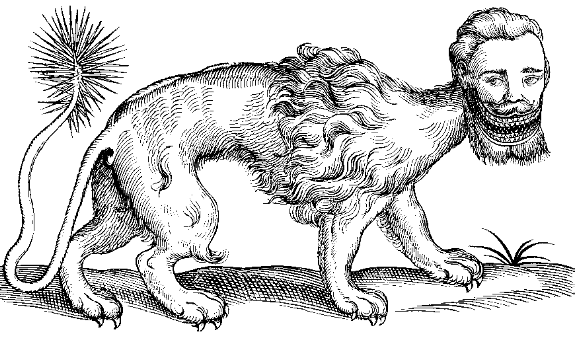
The Manticore, because of its human face, is often related to the Sphinx, even going so far as to make its prey answer riddles. Spiritually, it represents fraud because its face hides its true nature.
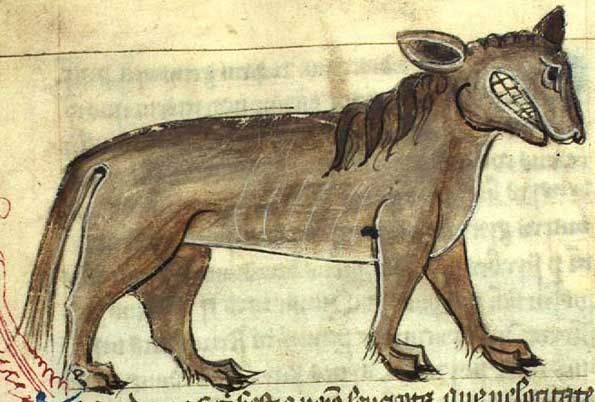
The Leucrota is another impossible combination made from the offspring of a hyena and a lioness. Now, through countless National Geographic Specials, lots of Animal Planet and, of course, “The Lion King,” we know that lions and hyenas do NOT get along, so unless there’s some kind of interspecies Romeo and Juliet thing that happened along the way, plus a good dose of miraculous genetic coding, this particular beast never existed.

Pliny the Elder went even further than hyena/lion in his description: “The leucrocota is the size of an ass, and has the neck, tail and breast of a lion, the haunches of a stag, cloven hooves, a badger's head, and a mouth that opens from ear to ear, with ridges of bone instead of teeth. It is the swiftest of wild animals, and is said to be able to imitate the human voice.”

The next two aren’t so much composite creatures in description, as much as they’re shown that way in illustration.
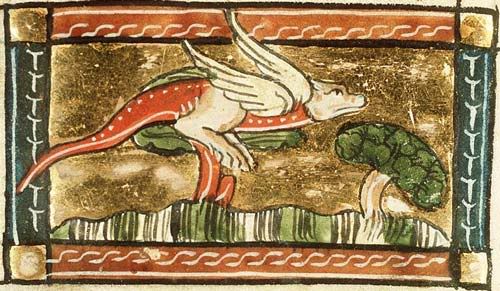

The Jaculus is a flying serpent often depicted with a serpent’s body, but the wings of a bird and the haunches of a beast. It waits in trees for prey to pass beneath, then jumps down and kills it.
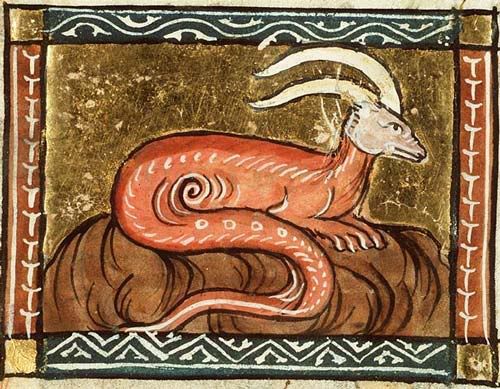
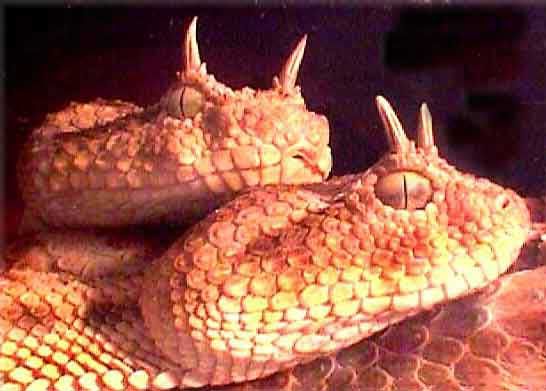
The Cerastes is very likely a Horned Viper, which is a real snake that lives in the Sahara Desert. The medieval illustration, however, depicts a serpent with the literal head of a horned ram.


My bestiary story has been moved back in my writing queue, so there’s no guarantee on what I’ll be talking about next time I blog. I may continue in this vein, I may go back to pantheons of gods – you just never know, so stay tuned!

15 May 2009

Gorgons


Snake haired, fanged furies of Greek myth. Popular mythology concentrates on Medusa, but there’s much more to these ladies than we learn from monster movies.

In fact, there’s some doubt as to whether there are one or three of them. And if there are three, why are two immortal (Sthenno and Euryale) and poor Medusa the only mortal?

The tales of one Gorgo come from the oldest myths, told by the poet Homer. The head of the Gorgo was taken to form the aegis of the shield of Athena. Even Euripides believed in only one monster. It’s Hesiod who transformed the tale to include three sisters, the daughters of Phorkys and Keta. He portrayed them with snakes and fangs, but Aeschylus gave them wings.

The early Classical poets agreed on one thing. The Gorgons were horrible to observe. Some of the images were incredibly creepy. It wasn’t until the later Classical period that poets and artists humanized Medusa from a monster to a beautiful, but cursed woman.

So back to my original question. How do you end up with two out of three immortal daughters? Wicked bad luck, is what I’m thinking.

Mortal Medusa was a beauty, the stories say. Some believe that she compared her beauty to that of Athena. We’ve already seen how that works out. *cough*Arachne*cough* But others feel that her fate can be laid at the feet of another god. One who wouldn’t take no for an answer. Medusa was a servant of Athena, but the great sea god Poseidon was enchanted by her beauty, so he seduced her in Athena’s temple. The virgin goddess turned her eyes away in horror, then punished Medusa by turning her lovely hair to snakes.

WTH?!? Girl has sex, so you turn her into a monster? Wow. That’s some seriously messed up logic (as well as a seriously uptight and repressed goddess), but Medusa’s tragedy doesn’t end there.

Now she’s even more super special than just being the gorgeous daughter of gods. No. Now she can turn men to stone with a glance because they’re so filled with dread at her hideous appearance.

See, now she’s a weapon, and we know how gods and warriors and heroes get all excited about new weapons. King Polydektes had challenged Perseus to bring him the head of the Gorgon, so he set off on his heroic quest, aided by Hermes, Athena (traitor!) and Hades.

The Graiaie guarded the cave where the Gorgons slept, but they had only one eye between them. Perseus stole the eye and bargained it for entrance to the cave. He used the reflection of his polished shield to find Medusa and cut off her head with one stroke.

However, in her death, Medusa gave birth to new life. The winged horse Pegasus and the giant Khrysaor sprang from her death-wound.

Perseus then brought her head back to his enemies, flying over Libya to get home. As he flew, drops of the Gorgon’s blood fell to the sand, creating fatally poisonous vipers in the desert there.

Medusa’s head was used to vanquish armies as well as the odious Polydektes, then turned over to Athena as the centerpiece for her aegis.

The End. *sniffle* She picked the wrong guy and died for it. No HEA for our girl Medusa.

But...could there be? I’ll let you know when I finish writing my current story, inspired by Medusa’s tale.