Showing posts with label mythology. Show all posts

25 November 2011

The Future of Myth

When I remember to blog, I usually blog about mythology. What is mythology but stories about how mankind has dealt with the big picture questions - Who am I? How did I get here? Why am I here? Where am I going?

Science insists that we crawled from primordial ooze. Various mythologies, however, give us beautiful accounts of the creation of man by gods and goddesses - all of which sound way better than evolving from bog bacteria. But those creation stories and our faith in them can seem very foolish in the face of the Almighty Scientific Fact.

What place, then, will mythology have in the future? Will there be room for stories about the big questions of humanity as anything other than something at which people far more educated in facts can point and laugh for our primitive beliefs and thought processes?

Will there be new gods and goddesses? New pantheons? New heroic sagas? Or are we at a place now where there is nothing new, only old stories and old gods that get recycled and retold for each new generation?

If that's the fate of our myths, our gods, then perhaps the new myths will be metaphors that turn the old gods new again. We will find new heroes who echo Hercules and Beowulf from a perspective we can't yet see. I hope the old stories will always be useful, will always teach us that there are things more powerful than mere facts. And I hope that our new myths reflect a better world.

05 August 2011

Characters from Mythology

Lucky is the author for whom characters spring fully formed from her imagination and onto the page, much like Athena from the head of Zeus.

Alas, I am no Zeus. Therefore, creating a character for me takes good old fashioned mortal, mental and mythological elbow grease.

Mythology provided archetypes of characters for millennia before Joseph Campbell came along. The Alpha Male, the Nurturing Female, the Brooding Loner, the Kick-Ass Chick -- there's nothing new under the sun.

But myths don't only provide the characters, they can also provide some framework for a story - ways to develop your characters into something more than archetypes. How many ways has Hades been transformed into the Beast who steals Persephone/Beauty from the love and light of her family? In the hands of a skilled storyteller, he's more than a distant immortal, an ideal from far away. He's a man in unending, soul-searing agony until he sees the one being who can give him surcease from his pain and loneliness.

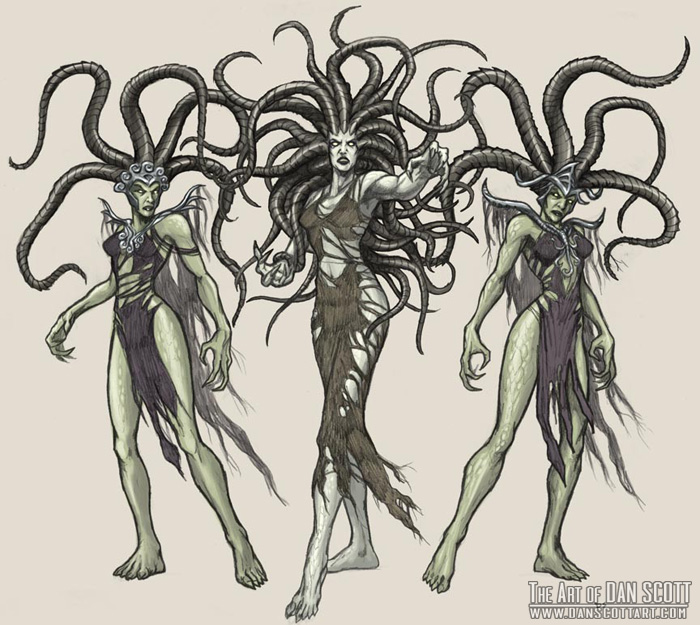
Sometimes, the myths are half-told. They give us a hint of a character or of a story and it's up to us to flesh out those few drops of inspiration. For instance, there are three Gorgons, but we only ever hear of Medusa. In fact, she wasn't even a proper Gorgon - she was a mortal woman cursed into that form by Athena. So what about the other two? Stheno and Euryale? What's their story?

When you're using an archetypal character, it helps to be able to see as big a picture of that character as possible. To go back to Medusa, it wasn't enough to simply see her as a monster with snakes on her head. I needed to know the myth inside and out. That's how I discovered that she was created by Athena for fooling around with Poseidon in Athena's temple. But that still wasn't enough, so I went back to the Gorgons. Why make her a Gorgon? They were protectors, meant to inspire terror in the enemies of the Olympians. In fact, Zeus put the aspect of the Gorgon on his shield, using the image of a power older than Classical Greece to reinforce his own power.

Older than Greek? Okay. I looked up ancient snake goddesses and snake symbolism. Ladon the serpent protected the golden apples of the Hesperides. Blood taken from Medusa's right side was made into a healing potion by Aesclepius. A snake is wound into a symbol of healing in the Rod of Aesclepius. Moses formed a copper snake and twined it around a pole to heal the Israelites. Snakes were regarded as wise and cunning and could even gift people with second sight. Wisdom? Healing? Protection? The worship of a chthonic (earth-based) serpent deity had as many positive notes as it did negative.

Suddenly, there's more to Medusa than a raging bad hair day. There's a character there. Not as neat and tidy as Athena from the head of Zeus, but a character formed from mythology, nonetheless, and with possibilities for theme and symbolism already built in.

So when you look to archetypes and ancient tales to build a story, be sure to cast your net wide. You'll pull in more than you dreamed!

Sela Carsen

01 October 2010

The Labyrinth


I think most of us know the story of the Minotaur.

The Minotaur was the offspring of Pasiphae (the wife of King Minos of Crete) and the Cretan Bull. Aphrodite gave Minos a perfect bull so that he could sacrifice it to her, but he decided to keep it instead. To punish him, the goddess made Pasiphae fall in love with the bull. Insert bestiality here and the Minotaur was born, the offspring of a human and a monster.

Minos had the monstrous child placed at the center of a labyrinth constructed by Daedelus and life went on until Minos's(1) son was killed by the Athenians in battle. Minos won the war and to punish the Athenians, he commanded that they send their seven best young men and seven loveliest young women to be sacrificed to the beast. They were released in the labyrinth and consumed by the Minotaur.

After a few of these sacrifices, the hero Theseus decided that enough was enough. He went to Crete where Minos's daughter, Ariadne, fell in love with him. She gave him the key to the labyrinth and a ball of string to help him find his way back. Theseus slew the Minotaur, led the Athenian youths out of the maze, and escaped Crete with them and Ariadne. (At this point, Theseus ceases to be heroic because he abandons Ariadne on the isle of Naxos. Jerk. She curses him to forget which color sails to raise on his way home and when his dad sees the black sails, he assumes Theseus is dead and throws himself off a cliff. Good start, bad ending.)

Anyway...back to the labyrinth. While the maze of the Minotaur is a myth, there is substantial archaeological evidence to suggest that there truly was a labyrinth at the Minoan palace of Knossos. The palace actually WAS the labyrinth!(2) The building was arranged so that it was virtually impossible for someone unfamiliar with the layout to navigate it. That doesn't really explain the whole bull-man thing, but it lends the ring of truth to the idea of the maze.

There are mazes from Ancient Egypt, as well. The labyrinth at Hawara (3) that was, according to Herodotus, "...it is hard to believe that they are the work of men; the baffling and intricate passages from room to room and from court to court were an endless wonder to me...."(4)

This labyrinth was originally constructed as a mortuary hall and built over several generations. The oldest name recorded at the temple was that of Amenemhat III, who also built the "Black Pyramid." The burial temples of the pharaohs were never forthright and even the contemporary archaeologist "Dr Zahi Hawass has said that when he first entered this pyramid he had a rope tied around his ankle to ensure he didn’t get lost inside."(5)

While the labyrinth at Knossos is certainly one of the most famous, it's not the only ancient labyrinth left for us by our ancestors. From the Bronze Age, there are petroglyphs of what's now known as the Classical or 7-circuit maze in India, Pakistan, Afghanistan and Sri Lanka.


There are labyrinths from the Bronze Ages - even some the Neolithic Age - that can be found throughout Europe. The vast majority of them reflect the same Classical form, which suggests that the symbolism of the labyrinth was in some way universal. However, it's impossible to know for certain. Labyrinths found in the Valle Camonica in Italy are usually found with scenes of battle and soldiers, where similar patterns in Galicia are surrounded by wild animals - a symbol of the hunt, perhaps.

Labyrinths aren't specific to the continents across the Atlantic, however. The Tohono O'odham, a Native American tribe in Arizona have a symbol they call "The Man in the Maze."(6) Petroglyphs of the maze, which features a man standing in the opening of the labyrinth, have been found at the Casa Grande Ruins.


But the real mystery is in the meaning of the labyrinth. As I mentioned, the Stone Age labyrinths seem to symbolize something...but what? Their meaning is unclear.
The Cretan labyrinth might have been merely the result of creative architecture, but was mythologized into a scenario of terror and death.

What, then, do those early symbols have in common with the labyrinths and mazes of the Middle Ages? And how do they connect to the modern-day resurgence of labyrinths as paths to inner peace?

The connection is entirely uncertain. People of many faiths today walk labyrinthine patterns to help clear their minds. It's said that following the path to the center of a labyrinth will help untangle problems as you meditate.

Whatever the symbolism, current or past, they provide an artistic framework for the famous "What if?" How can a labyrinth inspire you?

An excellent resource on labyrinths can be found at Labyrinthos.net.

(1)Minos's is correct according to Strunk & White's Elements of Style. The Chicago Manual of Style can go jump in a lake.
(2)http://www.explorecrete.com/Knossos/knossos.html
(3)http://www.labyrinthofegypt.com/art-science.html
(4)Herodotus, The Histories, translated by Aubrey de Sélincourt, Book II, pp. 160–61.
(5)http://www.talkingpyramids.com/dahshur/pyramid-of-amenemhet-iii/
(6)http://www.reznetnews.org/article/several-tribes-share-man-maze-30010

03 September 2010

The World Flood - Diluvian Tales in Comparative Mythology

Hey everyone! I know, it's been a long time since I blogged. I'm blaming it on my new catchphrase: I have A.D.O.S -- Attention Deficit...Ooh Shiny!

But I'm back now, so today is another post on mythology. I'm doing another Comparative Mythology bit, somewhat like the World Tree article I wrote some time ago.

This time, it's The World Flood.


I'm going to make a leap and assume that everyone knows the story of Noah's Ark. For those who left Sunday School behind some time ago, here's a quick recap.

Noah and his wife had three sons, who had three wives. During their life, the people of God were becoming increasingly sinful and wicked, growing further and further from God. It was time for a do-over. He decided if He could find one righteous man on the face of the earth, He wouldn't destroy mankind entirely. And there was just the one. Noah.

So God addressed Noah directly and told him what He was going to do. He directed Noah to build an ark so that one pair of each creature on earth could be saved. Noah started his ark, all the while telling people that God was mightily ticked off with them and fixin' to send a flood. (What? I was raised Southern Baptist.)

Noah built his ark, collected the critters and got himself and his family inside just as the rain started to fall. And fall it did. For 40 days and 40 nights, the earth was inundated with water. After the rain stopped, Noah found himself afloat with no landmarks because, hello, no land! So he sent out a raven to see if it would come back with some sign of land. Then he sent out a dove, but again, no luck. Finally, he sent out another dove, which returned with an olive branch in its beak. As the waters receded, he discovered he was atop what's now known as Mount Ararat, he let the critters out, made a sacrifice and the world started over.

In addition, God built a rainbow in the sky as a promise that he would never again flood the earth.

The End.

Except...not quite. The thing is, the idea of a flood wiping out the earth isn't purely a Judeo-Christian concept. The flood "myth" is very likely not a "myth" at all. Many cultures from the Mediterranean to the Near East share a similar story.

The Epic of Gilgamesh (Just saying his name makes me shiver. I love that story.) relates the tale of Utnapishtim. The gods of Babylonia decided mankind was too numerous and noisy, so it was time for a do-over. They decided that only Utnapishtim (also Ziusudra or Atrahasis) and seven others (let's see, 3 sons +3 wives + Noah's wife =7) could accompany him. The gods commanded Utnapishtim to build a big boat for all the critters, and then the rain starts coming down.

In Utnapishtim's story, it only rained for seven days and seven nights, but the desired objective was attained. Mankind was entirely wiped out except for those on the ship. He also sent out birds to discover whether there was dry land, and when the waters receded, he let the critters out, made a sacrifice and the world started over.

The gods promised they would never again destroy the earth with a flood.

If this keeps up, I'm just going to start copying and pasting.

So, all well and good that Israel and Babylon share a common flood myth. They're in the same part of the world, right? Well, how about a story slightly further afield, in India?

In this, the hero is named Manu or Satyavrata. One day, he finds a wee little fish in a wee bowl of water. The fish begs Manu to save its life by placing it in a bigger bowl. He does so and the fish grows. Every time, Manu places it in a larger container until finally it grows so large, he throws it back into the sea.

In gratitude, the fish warns him of a great flood that is coming to end this age of man. Manu is told to build a boat to save himself, his wife and a few chosen others (I'm betting there were 8 humans, but that's just a guess), seeds of all the plants, and two of every creature.

In the midst of the storm, a serpent god appeared as a rope, which Manu bound to the horn of another god-fish, and they were pulled to safety, landing in the Malaya Mountains.

No birds in this one, and the sacrifice isn't consistent throughout the different versions, but (copy/paste) when the waters receded, he let the critters out and the world started over.

Still too geographically close?

For our final version, let's head west again, to Greece. Yes, there's a Greek version of the flood myth, this time with Deucalion in the role of Noah.
Zeus had come to earth and met the evil king Lycaeon, who killed his own child and served it to Zeus for dinner. Disgusted with descent of humanity, he turned Lycaeon into a wolf ( Get it? Lycaeon? Lycanthropy? I do love when stories intertwine.) and decided to end the Bronze Age by divesting it of mankind.

He gets the gods together and they figure out how to wash the earth clean of men. Prometheus, however, was the father of the good King Deucalion and he warned his son of the coming flood. Deucalion and his wife, Pyrrha, constructed a boat and rode out the flood. In this version, no animals are saved, but they did come to rest atop Mount Parnassus, where they came out and worshipped the Corycian Nymphs of the mountain, as well as Themis, the goddess of oracles.

Seeing they were alone in the world, Deucalion prayed to Themis in his loneliness, asking how to rebuild the land. She told him and his wife to take up the bones of their mother, or the rocks of the earth, and throw them behind their heads. As they did, the stones that Deucalion threw became men and the stones that Pyrrha threw became women. The earth spontaneously regrew both plant and animal life, as well.

As I researched, the diluvian myths of other continents and cultures seemed to show up after the spread of Christianity, leading me to conclude that if they had flood myths, they were co-opted by Noahic tales so they're no longer reliable as historical markers.

However, the common threads of the stories from the Mediterranean Sea to India do seem to indicate that there may have been a massive, destructive flood of the Middle/Near East during ancient times and that it may have occurred within the same time period.

Two websites are good jumping off points for diluvian myths, although they also mention cultures which, as I said, may simply have co-opted the Biblical tale after coming into contact with Christianity.
http://www.talkorigins.org/faqs/flood-myths.html
http://library.thinkquest.org/C005854/text/mythfarworld_f.htm

(Art credit: Noah's Ark by Edward Hicks, 1846. Photo: WIKIMEDIA COMMONS)

15 May 2009

Gorgons


Snake haired, fanged furies of Greek myth. Popular mythology concentrates on Medusa, but there’s much more to these ladies than we learn from monster movies.

In fact, there’s some doubt as to whether there are one or three of them. And if there are three, why are two immortal (Sthenno and Euryale) and poor Medusa the only mortal?

The tales of one Gorgo come from the oldest myths, told by the poet Homer. The head of the Gorgo was taken to form the aegis of the shield of Athena. Even Euripides believed in only one monster. It’s Hesiod who transformed the tale to include three sisters, the daughters of Phorkys and Keta. He portrayed them with snakes and fangs, but Aeschylus gave them wings.

The early Classical poets agreed on one thing. The Gorgons were horrible to observe. Some of the images were incredibly creepy. It wasn’t until the later Classical period that poets and artists humanized Medusa from a monster to a beautiful, but cursed woman.

So back to my original question. How do you end up with two out of three immortal daughters? Wicked bad luck, is what I’m thinking.

Mortal Medusa was a beauty, the stories say. Some believe that she compared her beauty to that of Athena. We’ve already seen how that works out. *cough*Arachne*cough* But others feel that her fate can be laid at the feet of another god. One who wouldn’t take no for an answer. Medusa was a servant of Athena, but the great sea god Poseidon was enchanted by her beauty, so he seduced her in Athena’s temple. The virgin goddess turned her eyes away in horror, then punished Medusa by turning her lovely hair to snakes.

WTH?!? Girl has sex, so you turn her into a monster? Wow. That’s some seriously messed up logic (as well as a seriously uptight and repressed goddess), but Medusa’s tragedy doesn’t end there.

Now she’s even more super special than just being the gorgeous daughter of gods. No. Now she can turn men to stone with a glance because they’re so filled with dread at her hideous appearance.

See, now she’s a weapon, and we know how gods and warriors and heroes get all excited about new weapons. King Polydektes had challenged Perseus to bring him the head of the Gorgon, so he set off on his heroic quest, aided by Hermes, Athena (traitor!) and Hades.

The Graiaie guarded the cave where the Gorgons slept, but they had only one eye between them. Perseus stole the eye and bargained it for entrance to the cave. He used the reflection of his polished shield to find Medusa and cut off her head with one stroke.

However, in her death, Medusa gave birth to new life. The winged horse Pegasus and the giant Khrysaor sprang from her death-wound.

Perseus then brought her head back to his enemies, flying over Libya to get home. As he flew, drops of the Gorgon’s blood fell to the sand, creating fatally poisonous vipers in the desert there.

Medusa’s head was used to vanquish armies as well as the odious Polydektes, then turned over to Athena as the centerpiece for her aegis.

The End. *sniffle* She picked the wrong guy and died for it. No HEA for our girl Medusa.

But...could there be? I’ll let you know when I finish writing my current story, inspired by Medusa’s tale.

18 April 2009

The Snake Pit

Kukulcan

In Cancun, you see this word everywhere. On a sign for a cheesy souvenir shop. On a shiny, modern shopping mall. Even given to the boulevard that winds like a serpent's path through the Zona Hoteles.

What is the Kukulcan? A word made up to tangle up tourists' tongues? Being a word-oriented person who loves looking for deeper meaning behind seemingly innocuous place names, I went looking for the face lurking behind the Kukulcan...and found a legend.

The Kukulcan, like in many early cultures, is a supreme god that is represented in the form of a snake. Master of the four elements, possessor of all wisdom and knowledge, creator of the universe, guide through the labyrinth of death, resurrection, and reincarnation.

Originating from Toltec myth, the Kukulcan brought to his people the gifts of fishing, healing, the calendar, and agriculture. His name means "feathered serpent", and part of his name can be found in the very name of "Cancun", which translates literally into "snake pit."

As little as 50 years ago, the area we now know as the vacation destination of Cancun was a tangled jungle, a few Mayan huts along the shore...and dozens and dozens of species of snakes. Even that recently, if an outsider set foot on those shores, if the suspicious Mayan villagers didn't kill him on the spot, the snakes would eventually take care of him!

It's a myth, as well, that the Mayan people are extinct. They are as alive and thriving as the ancient culture they are determined to hold onto. If you're staying in Cancun, Mayans are cooking your food, cleaning your hotel rooms, owning and managing the shops where you buy handcrafts.

Generally small in stature (even the men are 5 feet tall or less), they wear the proud, strong facial features of ancestors that may stretch back to Asian lands, and carry themselves with a quiet dignity that is humbling to anyone who meets them.

Once they as a people were enslaved by Europeans who tried their best to stamp out the Mayan way of life and its revered serpent god as evil; now, like the snake god who can twist and turn on a dime, they have adapted to a new economy for survival - the tourist trade.

It is said the Kukulcan disappeared into the sea, never to be seen again. I beg to differ. The vibrant life force of the Feathered Snake still thrums like a heartbeat right under your feet - if you're brave enough to look and listen for it.


(Photo 2009 at Chichen Itza, Carolan Ivey)

20 March 2009

Spring is in the air!


Today is the first day of spring in the northern hemisphere, so it’s time to celebrate spring in mythology.

Let’s start with the Classical mythology of Greece and Rome. Okay, who remembers the word “chthonic”? It’s a Greek word that means “of the earth.” As in, the actual soil and interior of the earth. Many deities associated with spring and growth are chthonic, as they were worshipped in relation to agriculture, i.e. digging around in the dirt.

Gaia, for in stance, was a primal goddess in Greek mythology. She is the mother who bore the Sky and the Sea and all the Titans. She came before them all and was the embodiment of the Earth.

Cybele is also a Greek mother goddess, but her origins are slightly different. She springs from Phrygia, which is now part of Turkey. Another goddess, Rhea, fulfills a similar position, but she is Minoan.

One of Gaia’s offspring is Demeter, the Greek goddess of growing things, grain and fertility. Her Romance equivalent is Ceres. Demeter is a more Olympian goddess, though. While she is concerned with the bounty of the earth, she is also subject to the arrogance and thoughtlessness that characterized Olympian deities.

Demeter’s daughter Persephone, however, is more earth-based than Olympian. The myth of her abduction by Hades is something called an “origin story” or a story devised to explain earthly mysteries, such as the seasons. She spends six months of the year above ground with her mother, Demeter, helping things grow, then she returns to the Underworld for six months as the earth lies fallow.

Flora is a minor Roman goddess, one of many associated with fertility, but she has the distinction of a festival in her honor. Floralia was held at the conjunction of April and May and was celebrated with offerings of milk and honey. It was also a celebration that Rome’s prostitutes claimed as their own, so Floralia got pretty bawdy!

Moving on from the Classical world, the Germanic goddess Ostara or Eostre is in many ways the basis of our current Easter celebration. She is the goddess of dawn light and was celebrated with many items associated with fertility and fresh growth, such as hares and eggs.

Freya, the Norse goddess of fertility has associations with spring, but she’s more about the sensual than the agricultural.

Brigid is a Celtic goddess and her dealings with spring are specific to her role as a bringer of light because she rules over sacred flames. At the festival of Imbolc, traditionally celebrated on Feb 2 (Groundhog Day), she is said to bring the first light to the turning of the year.

Whichever mythology you prefer, though, there is a unique way to celebrate the warming of the earth and the fresh, renewing spirit of spring!

20 February 2009

Finnish Mythology


I’m back to my favorite topic today: Mythology!

I’m telling you, though, it’s getting kind of difficult to find Western mythologies to talk about. I really don’t know enough about Eastern cultures to feel comfortable with them, not to mention that some of what I consider mythology is still alive and well in some Asian countries, which makes it more of a religion discussion and to be honest, I don’t want to go there.

However, after some due diligence, I realized that there was one more untapped Norse civilization that I hadn’t discussed. The Finns!

Yep, we’re headed to Finland today.

Now, y’all know that I’m a language geek, yes? So it’s not going to surprise you when I tell you that the Finns have a fascinating and unique language. For its place on the map, Finland shares more linguistic heritage with Estonia and Hungary than with its Norse/Germanic-speaking neighbors, but it’s not mutually understandable with either Estonian or Hungarian. Essentially, Finland is a linguistic island in a continent of Indo-European languages. There. Geekness over. On to the fun stuff.

Today’s New Word is: MONOLATRY. According to Dictionary.com, it means “the worship of only one god although other gods are recognized as existing.” The Finns were monolatrists. And who was their supreme god? Ukka, the god of the sky, storms and lightning. As a sky god, he was literally the most highly positioned god in their pantheon.

The Finn’s mythic history, however, deals less with a pantheon of gods and more with an epic saga of heroes.

The main character of the Kalevala is Väinämöinen. He is the eldest and wisest of the Finns, possessing a powerful, magical voice. His quest to find a wife is what ties the first cycle of the Kalevala together. On his journey, he is accompanied by Lemminkäinen, an arrogant, handsome young god as well as the smith, Ilmarinen.
Love is gained and love is lost. The cycle of young Kullervo is rife with grief, rage and tragedy. But the thing that ties the Kalevala together is a magic mill of plenty called the Sampo. Ilmarinen forms the Sampo as a gift to the Maiden of the North, the daughter of the hag who rules Pohjola, which is the land to the north of Finland.

It’s a full, mythic tale, complete with the origin of man, death, self-sacrifice, rebirth and the end of the age of magic. Sound familiar? That’s because J.R.R. Tolkien borrowed heavily from the Kalevala for his LOTR legendarium.

From that historical tidbit alone, I think that the Finnish hero saga is worth further investigation.

You can find out more about Finnish mythology at these sites:
Godchecker.com
Wikipedia
Virtual Finland

For more about the Kalevala, look here:
Molly Kalafut’s site
Virtual Finland
Wikipedia

And just for fun, don’t forget to check that ultimate source, Scrooge McDuck! There’s an old Disney comic called The Quest for Kalevala. It’s from 1999, so I bet there are still copies out there at used comic places. Go forth and search!

03 October 2008

World Tree


I recently went though the list of specific mythos I’ve blogged about here: Breton, Irish, Slavic, Basque, Egyptian, Norse and Central American mythologies, as well as the occasional touch on Classical mythology. One thing that stood out is that several of these cultures share a “world tree.”

The Norse have Yggdrasil, where Odin hung for nine days to receive knowledge.
The MesoAmericans have the ceiba tree.
The oak tree of the Slavic gods.
The ashvastha, or sacred fig, of Hinduism.
An ancient religion of the Mongols and Turkic people believed in a world tree, culturally linking Siberia and Koreans. The Crown of Silla, one of the Three Kingdoms of Korea, portrays a world tree.
Judeo-Christian beliefs begin in the Garden of Eden, and Eve’s incident with the Tree of the Knowledge of Good and Evil.
Even Charles Darwin utilized the metaphor of a “Tree of Life” to illustrate his theory of evolution, where different species share a common ancestor.

The tree is a universal symbol of the different planes of existence. The branches in the realm of gods, the roots in the grasp of death, the solid trunk of mortality.

The Tree of Life is the constant in a constantly changing world, representing immortal wisdom, giving protection, rest and nourishment to its people. Only the brave and true may climb it and take its fruit and gather its strength. To become part of the tree, as Odin did in his sacrifice, is to become part of the godhead, part of eternity. To become part of the tree, or partake of its fruit, however, also requires sacrifice. Odin lost an eye for the privilege, Adam and Eve lost Paradise because they knew too much of sin.

It’s the permanent nature of the tree that draws us, as well as its ultimate mortality. The roots that draw food from the earth, the solidity of the trunk that provides a strong base, the branches reaching toward the sun, toward the light. The metaphor crosses all boundaries: no mountain or ocean can contain it, no language can distill it.

So next time you look out your office window, see what place the tree has in your story.

Image: World Tree by Doug Stapleton
Resources: “World Trees” by Hazel Minot
Wikipedia: World Tree See also, Tree of Life

08 August 2008

The Epic of Gilgamesh


Today’s trip into mythology goes a little further afield than I’ve gone before. Today, we’re headed to Mesopotamia.

First, the geography lesson. The heart of Mesopotamia lies between the Tigris and the Euphrates rivers. What we call the “Cradle of Civilization.” The Sumerian, Akkadian, Babylonian, and Assyrian empires were all Mesopotamian. Currently, that area belongs to Iraq, but all those ancient empires – kingdoms from Biblical times – lived and died around those two rivers.

Mesopotamia holds many treasures for us, mythologically speaking. The greatest of which is an epic tale of love and friendship, pride, sacrifice, sorrow and death. The Epic of Gilgamesh.

Gilgamesh was a real king of Uruk. Tales about him began to surface around 2100BC. A warrior, a diplomat, and a religious leader, the real Gilgamesh appears to have possessed genuinely heroic qualities. He is described in the poem as being “one-third human, two-thirds divine.”

Strong, sophisticated, powerful and beautiful, Gilgamesh ruled the city of Uruk well, but he had one weakness – women. Unfortunately, he wasn’t too interested in whether they really wanted him back, and their annoyed cries reached the ears of heaven. The gods looked down and said that they would create someone who would distract him and leave the women of Uruk in peace.

And so they took a lump of clay and created a huge, shaggy wild man named Enkidu. He roamed the forests with the animals, even saving them from the snares and traps of hunters. They finally got fed up with not catching anything and approached Gilgamesh, saying that they were too afraid of Enkidu to catch him themselves.

Gilgamesh, knowing his own weakness, decided that Enkidu might be the same. He told the hunters to take a harlot named Shamhat out to the forest where she could tame the wild man.

Apparently, they set the forest rockin’. Afterwards, however, Enkidu discovered that she had weakened and humanized him enough that his animal friends no longer welcomed him. A tough lesson in judgment, but Shamhat helped him out. She told him to go to Uruk where he might find a true friend in Gilgamesh.

He set out for the city, but upon his arrival, discovered that Gilgamesh was up to his old tricks. He was preparing to exercise his right to sleep with a bride on her first night with her husband. This struck Enkidu as barbaric (does anyone else see the irony here?) and he and Gilgamesh fought a mighty battle through the streets of Uruk.

Enkidu, though no longer as strong as his animal companions, was still more than a match for Gilgamesh and he defeated the king. However, Enkidu’s humanity and humility were the perfect foil for the “two-thirds divine” king’s selfish pride. Instead of becoming rivals, they became inseparable companions.

The epic tells of many adventures, but it hinges on the defeat of one Humbaba (or Humwawa – transliteration is an imprecise thing.) Humbaba was the forest guardian and servant of the god Enlil. Gilgamesh and Humbaba fought and Gilgamesh won. However, he went too far. Despite Humbaba’s pleas for mercy, Gilgamesh and Enkidu both participate in his execution.

Filled with pride at his victory, they return to Uruk. There, the seductive goddess Inana propositions Gilgamesh, but he refuses her. Not only that, he insults her, throwing in her face all the lovers she as ruined and all the gods she has scorned.

You know that saying about the fury of a woman scorned? Inana was furious. She went to the gods and demanded revenge. This insult, combined with the death of Enlil’s servant, compelled the gods to send down the Bull of Heaven to defeat Gilgamesh and Enkidu.

The gods really don’t seem to have grasped the power of the heroes that they themselves created. Gilgamesh and Enkidu not only defeat the Bull of Heaven, they throw one of its bloody limbs in Inana’s face.

It’s an unpardonable offense and someone has to pay. The gods decide that Enkidu will bear the punishment. Over twelve days, Enkidu wastes away from a debilitating illness and Gilgamesh is forced to watch his dearest friend in the world die. It changes him more than anything else by bringing his own mortality to his attention.

Gilgamesh is a shadow of his former self. He abandons his city and travels to the Underworld to seek a way for him to become immortal. He is terrified of death. He meets Ut-napishtim – a Mesopotamian version of Noah – and asks him for the same immortality that he has achieved. After many trials, Ut-napishtim finally tells him to take a fruit of a tree.

Here, the story diverges a bit. In one version, the fruit will grant Gilgamesh the immortality he seeks. In another, Ut-napishtim tells him that everything must die, but the fruit will bring back his friend, Enkidu.

In any case, as Gilgamesh travels back to Uruk, he falls asleep by a stream and a serpent steals the fruit. Now he has neither unending life for himself or a new life for his friend. He returns to Uruk and spends his last few years grieving and brooding in the city.

It’s a tragic tale, to be sure. None of the happy endings that we’re used to as romance fans. But it has great power, even in its sadness. Not to mention that it provides us much inspiration for brooding heroes and a glimmer of possible redemption. After all, weren’t Gilgamesh and Enkidu reunited in death? Granted, that’s not how we want our books to turn out, but the possibility exists.

I hope you enjoyed this brief glimpse into Mesopotamian mythology. There are many other tales of gods and goddesses and all their tricks, but I’ll save them for another time. The story I told was synthesized from three sources:
Wikipedia: The Epic of Gilgamesh
Mythology: The Illustrated Anthology of World Myth & Storytelling
Mythology: Myths, Legends, & Fantasies

16 May 2008

Mythology Workshop and Bad Vampire Movies

I usually blog about different mythologies, but right now I'm utterly absorbed by a free workshop that's happening.

Go over to the Romance Divas website. Join up, if you haven’t already (it’s free) and head over to the Class In Session section for the USING MYTHOLOGY IN ROMANCE workshop that’s going on right now. As in, Right Now.

Lori Handeland is talking about how she combines Navajo mythology with Biblical eschatology (study of the end times), vampires, werewolves, and coyote shifters. Robin Owens is discussing some of her world-building tips. Gena Showalter explains how she tweaks myths to get what she needs. And Nancy Madore is talking fairy tale archetypes.

Our other guest authors will be joining us as they can, so stay tuned. If you can’t join in the discussion today, it’ll stay in the archives for later research.


I was going to write a post all about the Worst Vampire Movies Ever, but realized that I haven’t made a habit of watching terrible vampire movies. Two, however, recently crossed my radar.

One day in a fit of housewifely industriousness, I was ironing and decided to watch a little TV to take my mind off the excruciating boredom. SHADOW OF THE VAMPIRE had just started, so I flipped there. Hey, it said Cary Elwes was in it, which is usually good enough for me.

Sweet. Baby. Nosferatu. First, John Malkovich does accents even worse than Kevin Costner, who can’t do them at all. Second, just wow. And not in a good way.

It’s about the making of the silent film, Nosferatu, back in 1922. Apparently, the original film was plagued with misfortune – people disappearing and dying. So the whole cast is doing these really dreadful German accents, except for Udo Kier, who actually IS German, so he at least sounds normal. Willem Dafoe is totally unrecognizable as Max Schreck, who played Nosferatu.

I honestly thought the movie was supposed to be a spoof. Eddie Izzard is in it, for crying out loud. But no. People took it seriously. It won dozens of awards! I just don’t get it. Maybe I’m not clever enough to watch American films about European films. I’d seriously give this one a pass unless you’re in the mood to watch otherwise excellent actors chew up the scenery.

The other movie was a late night “Gee, I’m awake, so I’ll see what’s on.” BLOOD FOR DRACULA is at least supposed to be funny. And it succeeds simply because it’s so over the top.

Udo Kier (what is it with him and cheesy vampire flicks?) portrays a dying Dracula in this 1971 film. He doesn’t just drink any blood. No, he’s gotta be picky. It must be a virgin’s blood. (Pronounced “wirgin.”) So he sets off to Italy and finds a poor, upper-class family with four daughters. Surely, one of them must be a virgin. He starts with the middle two, who are pretty, but slutty. They’ve been banging the help, played by Joe Dallesandro. Pretty face, great abs, but if only he wouldn’t talk so much. I’ve never heard the word “whore” pronounced “hoo-ah” before. And then there’s the fun little twincest thing they’ve got going on. Drac tries to drink from them, but gets sick because they’re not “wirgins.” At this point, the movie is pretty much a sex farce with Udo regurgitating buckets of blood everywhere. The ending is one of the funniest bloodbaths ever. Remember the movie, “Buffy the Vampire Slayer” when Paul Rubens dies? Yeah. Like that. Only more.

I suppose it’s worth mentioning that Andy Warhol was one of the producers. And that Roman Polanski played a bit part in the film. You know, that really explains a lot.

So, what are the worst vampire movies you’ve ever seen?

13 May 2008

Mythology Workshop May 16-18


Everything Old Is New Again – Using Mythology in Romance


May 16, 17, and 18 at Romance Divas


Featuring:

P.C. Cast

Robin D. Owens

Gena Showalter

Nancy Madore

Lori Handeland

Alyssa Day


Want to know how to use mythology, culture, fairy tales, or folklore in romance? Romance Divas is hosting a 3-day workshop with some of the hottest names in the genre. It will take place at the Romance Diva Forum. All are welcome. To get access to the forum you will need to register.

18 April 2008

Ergot, Schmergot

Werewolves. Yummy, sexy werewolves. Unless, y’know, they’re the horrifying, monster, eat-your-face-off kind of werewolf.

I’m sure by now we’ve all heard about some of the origins of werewolves and lycanthropy. That whole moldy wheat scare in the Middle Ages that convinced some people they were wolves. Hey, did you know that Ergot is one of the base ingredients in LSD? Yeah, I’d hallucinate, too. That theory is actually pretty far out there. There’s no scientific, physiological basis for lycanthropy, which is derived from the Greek for lycos (wolf) and anthropos (man).

But aside from food poisoning or mental illness, how did the tales of men becoming wolves begin? That’s difficult to track. Humans and wolves have had intimate connections throughout history. Witness the tale of Romulus and Remus, raised by a she-wolf. Greek mythology gives us the story of Lycæon, who was cursed into a wolf’s form after serving Zeus a dish of human meat.

Stories of werewolves abound primarily in Europe and most of them are evil. No. Not just evil, but eeeeeeeeeevil. Malevolent witchcraft and grave mortal sin surround those who succumb to the wolf. For some, the change is involuntary, the result of a curse laid on them. For some, however, it’s a perfect cover for serial murder.

Not quite a werewolf tale because there’s no hint of human transformation, the story of the Beast of Gévaudan tells of over 80 deaths in south-central France during the 18th century. The attacks are attributed to a monstrous wolf-like creature.

Seventh sons, sorcerers, drinking water from a wolf’s paw print, or wearing a belt made from a wolf’s hide are often noted as methods of becoming a werewolf. Also being a Christmas Eve baby in Russia, or certainly having parents who are werewolves will increase your chances of turning furry in the moonlight. Being bitten by a werewolf is a modern-day fiction, rarely found in older, more traditional legends.

The one exception in the old stories where werewolves aren’t pure evil comes from a 1692 trial of an elderly Livonian man named Thiess. Almost all the references I’ve found to this story seem to be direct copies of the information on Wikipedia, so take it with a gigantic salt lick. Anyway, Thiess claimed that werewolves were actually the “Hounds of God” – warriors who went down into Hell and did battle with the Devil and his minions. When they died, they were welcomed into Heaven for their services. He got ten lashes from the Inquisition for idolatry and superstition.

There are two medieval stories, both from around the same period, one French, one from Breton. The original story is probably Bisclavret, written by Marie de France in the 12th century, one of a dozen lais she wrote that were transformed into other tales. The Lay of Melion is Breton and relates to Arthur. In an earlier blog, I mentioned that Brittany has closer ties to Cornwall than France.

Bisclavret/Melion tells of a valiant and good knight who is married to a treacherous woman. The knight goes to hunt and the wife tricks him into revealing his secret. He’s actually a werewolf. From what I read, the stories don’t go into detail of how he became a lycanthrope. In Bisclavret, he needs to keep his clothing in a safe place or he can’t become human again. In Melion, there’s a magical ring that transforms him. As soon as the knight becomes a wolf and goes off to hunt, the wife steals the clothing (and in Melion, the ring, as well) and disappears. For years, then, the knight is condemned to wander as a beast of the forest.

Eventually, the king (Arthur, in Melion) goes out hunting and encounters this wolf. Melion/Bisclavret had been a friend of the king and goes to him in friendship. The king recognizes the strangeness of this and decides to keep the wolf as a companion. After some time, however, the estranged wife and her lover show up at the king’s court. The wolf goes mad, attacking the couple. In Bisclavret, he actually tears off her nose. The king, knowing that the wolf has never acted like this with anyone else, investigates and the evil-doers confess and tell where they’ve hidden the knight’s belongings. The wolf puts on his clothes and becomes human again. The wife and her lover are banished and in Bisclavret, all the wife’s children are born without noses.

The history of werewolves throughout the world is a gigantic study. Tales of lycanthropy differ from culture to culture and the modern version of werewolves differ significantly from the old horror stories. We’ve anthropomorphized them, made them more human and accessible. Indeed, we’ve made them heroes, but who can blame us? The ultimate alpha, that touch of animal lust. The shape shifter in all his forms is a romantic mystery we love to unravel.

18 January 2008

Library of Mythology


I would like to point out that I actually wrote this post yesterday. Because I forgot what day it was and I thought yesterday was Friday. For once, it turns out that I was a day early! This is important because I don’t always remember when it’s my day to blog. That would imply that I was in any way organized, which, clearly, I’m not. However, I actually put a few minutes of thought into this post and instead of my usual what weird mythology is Sela going to dig up today, I decided to talk about myths on a more …writerly level (Is that even a word? It is now.)

I spent some time over at Teach Me Tonight this week and, aside from discovering a wonderful new blog, I learned a lot about how writers write. See, our brains are “aglow with whirling, transient nodes of thought careening through a cosmic vapor of invention.” (Brownie points to the one who can name that movie quote.) Everything we’ve ever seen or read or heard lands on the fertile ground of our imagination, but we only become writers when we take that gigantic mess of stuff and transform it into a story.

Myth is the basis for thousands of contemporary stories – and nobody “owns” a myth. They may own the way they tell it, but the kernel at the heart of their story is free to whomever can write it a new and fresh way.

So where do we learn about myths to begin with? What puts them into our whirling nodes of thought? Where did you hear your first myth, and know what it was?

The first myths I learned were probably Norwegian. We lived in Norway for a couple of years before I started school and I remember tales of forest trolls and tiny, Santa-like “tomtes.” Then we moved to Egypt and the stories of Ra, Isis and Osiris were in the very air I breathed.

That’s when I started collecting books of fairytales and myth. Over the years, I’ve amassed quite a few. From my first East of the Sun and West of the Moon to my most recent purchases – two huge encyclopedias of mythology: Mythology: The Illustrated Anthology of World Myth and Storytelling, and Mythology: Myths, Legends and Fantasies.

I swear, I’m as happy as a mosquito at a blood bank.

Aside from these, I own D’Aulaire’s Book of Norse Myths, Bulfinch’s Mythology, and volumes of Welsh, Irish and English myth. I also treated myself to the New Verse Translation of Beowulf. But I don’t get all my information from these sources. I also have several sites bookmarked online that I use for reference.

Ancient Worlds.net is a gathering place for several different ancient cultures.
Timeless Myths is handy for Norse studies, as well as Celtic and Arthurian legend. Contains some information on Classical mythology.
The Encyclopedia Mythica is useful for looking up gods of all different cultures – if you know their names. It’s not designed to discuss an entire pantheon as a whole.
And yes, I use Wikipedia shamelessly. At the very least, the cross-referenced articles are a gold mine of information.

What’s in the myth section of your personal library?

07 December 2007

The Selkie Legend

My latest release, HEART OF THE SEA, is based on an old myth about shape-shifting seals. The Orkney Isles in particular, lay claim to these stories. The word “seal” in the Orkney dialect is “selkie.”

The theme of the LOVE & LORE anthology is Celtic mythology, and there are Irish roots to my story, but the Heart of the Sea itself, the magical amulet on which the story hinges, goes all the way back to the ancient gods of the Northland.

It’s believed that the stories of the seal-people came from a source further north. In the north of Scandinavia, live a people called the Saami. They practiced the Old Norse ways longer than any of their Norwegian neighbors. The Orkney Isles were on a path the Saami used for trade and settlement and it was a legitimate part of Norway in the 13th century. Place names and dialect put Orkney closer to its Norse roots than its Scottish ones. Gray seals in the east Atlantic travel the same paths now, from the UK and Ireland up around the Orkney Islands, Iceland, Norway, and further.

Selkies are creatures of pure magic and the magic lies in their skin. They’re able to cast off their wondrous pelts and take form as humans. But if the skin is lost or stolen, then they’re stuck in human bodies until the skin is recovered. As soon as they find it again, they snatch up their fur covering and rush back to the sea.

Both selkie men and women are extremely attractive to humans. A common theme is when a human man sneaks off with a selkie woman’s sealskin. She’s trapped on land and has no choice but to marry the man who holds her pelt.

It often ends sadly, though. Many years pass and though she seems happy enough, she still longs for her watery home. It’s frequently her children who, by trying to cheer her up, tell her where the skin is hidden. She takes it back, bids farewell to her children, and returns to the sea, never to be seen again.

Happily, Heart of the Sea both begins and ends with the myth a bit backward. It’s the story of a human woman who turns into a selkie through a family curse and while she’s trapped in the body of a seal, longs for her home on dry land.

There are many retellings of this myth. I recommend Orkneyjar.com’s interesting pages about the heritage of the islands and the Selkie Folk. They have several different stories about Selkies. Another website is A Home for Selkies. They have quite a few poems and songs linked on their site. In addition, The Seal Prince, a children’s book by Sheila MacGill-Callahan is beautifully told and illustrated.

I also highly recommend the film, “The Secret of Roan Inish.” It’s a beautiful story within a story – framed by the Selkie myth.

16 November 2007

Breton Mythology


At the very northwestern tip of France lies a region called Brittany, or Bretagne. Directly north of it, across the English Channel, is Cornwall. And a very long time ago, they weren’t so different from each other.

When the Romans came to Gaul, they called the area “Armorica.” Trade between Armorica and Britain had been long established and Brittany had far more in common with Cornwall than with its Frankish neighbors to the south. They even shared a language across the strip of sea.

So it’s no surprise that they also shared a mythology. It’s difficult, however, to find much information about it. The French are a trifle tetchy about their Barbarian roots, so there hasn’t been much research forthcoming from them. What survives are the folktales of the area and a strong link to the Arthurian cycles that come from Cornwall, Devon and Wales.

I’m not going to go into the Arthurian legends in this article, but talk about some of their folklore instead. First, we’ll start with the Grim Reaper himself – Ankou. That’s a picture of the jolly guy himself. Charming.

But the mythology indicates that we base our modern image of the Reaper on Ankou. Tall, wearing a wide-brimmed hat and a long coat. He doesn’t carry a scythe, but rattles along on a rickety wooden cart, into which his skeletal helpers toss the bodies of the dead. If you ever hear the rattle of his cart on a misty Breton moor, you’d better run before you end up as cargo!

The Breton Korrigan is, in some tellings, very similar to the Cornish pixie. Troublesome, but not usually malicious, depending on the tale. If these female sprites steal a mortal baby, they raise it as their own. They’re also associated with water and in these instances are beautiful creatures with long flowing hair – but their sexuality is dangerous. If a mortal man falls in love with a korrigan, he is usually doomed to die.

Other tales of the Korrigan can be found at Celtic Twilight

Morgens are also water sprites (Brittany is a peninsula, surrounded on three sides by water – no wonder there are so many water sprites in their mythology). Again, like the Korrigan, her beauty is dangerous. She lures men to their deaths by showing them glimpses of undersea treasures. But her power isn’t always deadly. The Lady of the Lake in Arthurian legend, is named Morgen. And the story of Morgan Le Fay, Arthur’s half-sister, may have risen from Breton tales.

The last water-spirit of Brittany is the cannard noz. She’s the Washer Woman common in almost all Celtic mythology. In Breton, her name means “night duck” because she has webbed feet. In Ireland, she’s the Bean Nighe. She washes the grave clothes of the dead and is a portent of death. You don’t want to catch a glimpse of her at work.

Finally, we come to the legend of Ys. Ys is the Celtic version of Sodom and Gomorrah. There was a good and faithful king named Gradlon, who ruled wisely and well, but his daughter, Dahut, was a wicked young woman who reveled in sin. The city of Ys was built below sea level and protected by a dike. The king kept the key to the dike on a chain around his neck.

Dahut stole the key to let her lover – supposedly the Devil himself – into the city and retribution arrived. The entire city was swallowed up and only King Gradlon was saved. He went on to found the city of Quimper and when he died, a statue was erected of him on horseback, pointing back to Ys.

Dahut became a mermaid who haunts the waters in the Bay of Douarnenez and in stormy weather, the bells of Ys still toll to warn seafarers from the shore.

Here’s the thing. There’s a good deal of evidence pointing to the fact that Ys was apparently real. There are Roman roads that lead to it, Gradlon is pointing to it, and several of the locations mentioned in the legend are real. In addition, there’s a 5th century account of a Breton city being swallowed by a deluge.

You can find more information about Ys at The Legend of the City of Ys and Brittany’s Legends.

So there you have it. The folklore of the Breton. It’s easy to see the links to other Celtic and Welsh myths and the history that binds the cultures together.

For more information on Breton mythology, see Legends and Romance of Brittany by Lewis Spence, compiled in 1917.

12 October 2007

Irish Mythology


I actually started out this article as one on Celtic mythology. Umm, no. The concept of the Celt is too big for just one article. There are the Irish, the Scots, the Welsh and the Britons. Then there’s the whole historical influence of the Gauls and Romans. So today’s article is just about Irish mythology.

And I say mythology because I can’t really talk about a pantheon, per se -- a system of god-worship. Irish mythology focuses on the Tuatha Dé Danann, or “the people of the goddess Danu.” There, I’ve just contradicted myself. However, little is known about Danu as an individual. She’s “the mother,” but there doesn’t seem to be much focused worship of her as a mother goddess the way, say, Venus or Cybele were revered in classical mythology.

The Dagda was a powerful god figure, and several of the Tuatha had specific focii – the Morrigan was a goddess of war, Aengus was a god of love, and Manannán was the lawgiver and the keeper of the doorway to the Otherworld. Yet these characters are often portrayed as magical beings, immortals, and legendary characters, rather than gods to worship.

The stories of the Tuatha Dé Danann are recorded in the Mythological Cycle of the Lebor na hUidre, a manuscript that can be dated from the 11th century, along with the Book of Leinster (c. 1160), and the Lebor Gabála Érenn (the Book of Invasions) from the late 11th century.

As in many other mythos, numerology plays an important role. There are four treasures of the Tuatha Dé Danann:
The Dagda’s Cauldron: A large cooking pot that never emptied and none left hungry.
The Spear of Lugh: A spear that lived. So bloodthirsty that it could only be controlled by keeping its head steeped in a vat of opium. When it was awake, it roared and struggled against its holder, eager for the slaughter.
The Stone of Fal: The Lia Fáil, also, the Stone of Destiny. When the rightful King of Ireland places his feet upon the stone, it roared in joy. Cúchulainn split the stone in half when it did not acknowledge his heir. After that, it roared only under the feet of Conn of the Hundred Battles and Brian Boru.
The Sword of Light of Nuada: Nuada Airgetlám was the first king of the Tuatha. He lost his arm in battle, and had it replaced by one of silver. The Sword glowed with a silver light and was irresistible in battle.

Four treasures, four elements, four suits in the Tarot. Balance is important in this mythology, as in most.

For the most part, Irish mythology is a tradition of heroic tales, of kings and courts, politics and war. By the Middle Ages, the Tuatha themselves were less magical and godlike than legendary figures of history.

Magic, however, still thrives on the Green Isle. A lack of gods does not preclude an active folklore filled with pixies, brownies and leprechauns, as well as other magical peoples connected to the land and nature.

There is always more to learn about this complex culture, so I encourage you to read through the following list to discover more.

Sources:
Irish mythology at Wikipedia
Irish folklore
Library Ireland
The Tuatha at Encyclopedia Mythica
Timeless Myths

01 October 2007

Autumn

My favorite time of the year is at hand. How many of you love the chill in the air, the leaves fluttering down from the trees and the jog toward the holidays as much as I do?

The only thing I really don't enjoy about the change of seasons is the fact that I usually catch a cold. In fact, I've been recovering from a cold/flu kind of thing I caught during my weekend in Kentucky. (See my last blog entry for details on that fun event.)

I was recently doing some research into Iroquois mythology and came across the following interesting story (paraphrased from Wiki):

"Sosondowah was a great hunter who was captured by Dawn, a goddess who needed him as a watchman. He fell in love with Gendenwitha, a human woman. He tried to woo her with song. In spring, he sang as a bluebird, in summer as a blackbird and in autumn as a hawk, who then tried to take Gendenwitha with him to the sky. Dawn tied him to her doorpost. She then changed Gendenwitha into the Morning Star, so he could watch her all night but never be with her."

It's kind of beautiful and sad at the same time, but what struck me -- as odd little facts usually do -- is that in Autumn, Sosondowah was a hawk. The fierce hunter, wrapped in the colors of turning leaves and fading crops, the brown feathers, hooked beak and keen eye of the predator. It seems fitting and rather intriguing at the same time.

I wish you all a joyous Autumn and if you should see a hawk in your travels... remember, he might just be Sosondowah, keeping watch.

Bianca
http://www.biancadarc.com/

01 September 2007

Dragons - myth, or alien?

I spend what I admit is too much time skimming along the the surface of the web, letting a random word or image draw me into a nugget of knowledge. Sometimes it is for legitimate research - people, places, or ideas I'm gathering background on for writing. Sometimes it's just for entertainment. (Yes, I'm addicted to Perez Hilton's website, and share his lurid fascination with Brittney, Lindsey, and Paris.)

But I love when I find an article or bit of writing that makes me sit up and think. Like this one : "Chinese Dragons - Ancient Flying Machines"

In a very small nutshell, this site tells of how the early chinese wrote of gods, coming "down from heaven in the bellies of dragons." Of immortals who could fly through the air, called "flying immortals".

"Everything began with the dragon", a manuscript says. The dragons belonged to the race of gods.

The European view of dragon myth has long been that stories of giant beasts were just that - stories, created out of a need to explain the great bones and fossils of dinosaurs that were occasionally unearthed.

But what if there is something more to it than that? Something both mystical, and otherworldly. Could the 'dragons' have been visitors from another world? Not gods, but beings who appeared godlike in their greatness. Aliens who came in great flying objects, which must have been both fearsome and amazing to behold.

What do you think? Do dragons belong in the realm of myth, or could they be proof of alien visitation?

31 August 2007

Slavic Mythology

I apologize for missing my last turn, but I’m making up for it today with a short article about Slavic Mythology.

Sure enough, there be gods in Eastern Europe. From Macedonia (just above Greece) all the way to Latvia (just south of Finland) and including more than a dozen countries both large and small with ever changing regimes, borders and dialects.

In fact, there is a movement in the Baltic (Northern Slavic) countries to return to an ethnic polytheistic pagan religion called Romuva, which worships the old gods and is important in preserving Baltic folk traditions.

If you remember, we talked about Basque mythology recently and one of the problems in researching is that Christianity had been around for so long that many of the traditions were forgotten. You know, what with the Inquisition burning thousands of Basque pagans and all. The issues surrounding research into Slavic mythology have some of the same issues. Not necessarily due to the Spanish Inquisition – totally unexpected – but because of centuries of Christian influence in the area. In addition, the Slavs had no written language prior to their Christianization, and many stories were no doubt lost in the mists of time.

One thing that struck me in my study was the recurrence of a World Tree, which we’ve seen in Norse mythology and in Central American mythology. As in other cultures, the tree – an oak this time – was symbolic of the different levels of existence. The crown represented the heavenly deities, the trunk was the realm of mortals and the roots of the tree stretched into the underworld.

As opposed to many of the cultures we’ve studied, the underworld of Slavic mythology was actually very nice – not a world of fire and judgment, but of eternal spring. The tree was also organized along the four cardinal directions of the wind (horizontal axes) and the various levels of the tree (vertical axes). To correspond, there was the three-headed god, Triglav, the god of prophecy and soothsaying, and Svantevit, the four-headed god of both war and harvest. An unusual combination.

As to major gods, there were a few. Perun was the top guy. The god of the thunder, lightning and fire. He was also a dry god. This is important in a minute. He drove a chariot across the sky (Apollo, much?), hurled a hammer (Thor, much?) at evil spirits and lived at the top of the World Tree. His opposite number is Veles, the god of the underworld. Naturally, they were enemies. Veles was a god of peasants, cattle and wealth. He was a wet god. Represented as a dragon or serpent, he would steal Perun’s cattle. Dry periods were the result of Veles thievery and trickery of Perun. When Perun went after him to get his cattle back, a great battle would ensue – big storms with lots of thunder and lightning. The battles would result in the defeat/death of Veles – when his body was split open by Perun’s sword, the great rains would fall and order could be restored.

There are a number of smaller deities who controlled or symbolized other aspects of life for the Slavs. Czernobog represented the darkness of winter and was accordingly a bleak and forbidding god. His position was overtaken in the spring by the other half of himself, Bielobog, a god of sun, light, and life. The Czernobog/Bielobog deity, however, is unsubstantiated by modern research because of the dearth of proof. Indeed, while Czernobog is fairly certain to have existed within the pantheon, the only theory of Bielobog’s existence is merely the conjecture of a 12th century priest who assumed that the evil of Czernobog *must* have some balancing force – not necessarily true.

The Zorya were a trilogy of sister goddesses who symbolized the passage of the sun and moon. They are the Morning, the Evening, and the Midnight Star, guarding the gates of heaven for the passage of the sun. They also stand guard over the doomsday hound, who, if he ever breaks his chain, will eat the constellation of Ursa Minor. If he ever does, the universe will end.

The Slavs also have a rich and varied folklore consisting of goblins, fairies, witches, dragons and firebirds. For more information on that, see this University of Alberta link and this one from the University of Alabama. Those are also good sources for the mythology we’ve discussed here. See also the Slavic Pantheon. Wikipedia, as always, is a good jumping off point for further research, but my other two favorite pantheon sources, Godchecker and Encyclopedia Mythica, are sadly lacking in this area.