Showing posts with label Betrayal. Show all posts

22 March 2013

Betrayal and conflict

"It is easier to forgive an enemy than to forgive a friend." (William Blake)

Betrayal can create the strongest conflict in any type of story. It fuels a wide range of emotion from anger to depression. It can take an otherwise average character and turn them into a vengeful hero, heroine or villain.

There are a lot of great examples of betrayal and its aftermath in one of my favorite television shows: Once Upon a Time. From a young Snow White's innocent betrayal of a secret, to Rumpelstiltskin's manipulation of, well, everyone, to get what he wants... the show is ripe with examples of betrayal and conflict.

In a television series, it's a bit easier to deal with conflict because as a writer you have plenty of time and room to play out a storyline without it feeling forced or rushed. In a novel, however, it isn't quite as easy. Your space, as it were, is more limited. If the betrayal is too unforgivable, but you need the character to forgive, as a writer you have to craft the story very carefully.

I've written characters that have betrayed one another or seemed to (Jason and Sabrina in SECRETS AND SHADOWS). I have characters that betrayed themselves through addiction (Ian in DREAM WALK) and other bad choices. Then there are characters motivated to become heroes by a betrayal of some sort (Camille in DREAM WALK).

Finding that balance between the desire for justice and the need to forgive -- it's a conflict as old as time. What act or action is just too unforgivable? It depends a lot on your characters, the story itself, and how you handle it. Telling a secret is more forgivable than, say, infidelity, which is likely the most difficult conflict in any romantic relationship, be it fiction or reality.

Now I need to get back to my work in progress (wip), and another betrayal of sorts: withholding the truth. Telling the one you love a lie is a big no-no in the romance world. It creates mistrust and can destroy a relationship unless, at some point, the one lied to is willing to forgive. Will she? Won't she? I'm not telling... but just remember I do write romance, and there's always a happy ending.

~~Meg Allison
 Sultry romance cloaked in suspense...
Sweeter stories laced with laughter.
http://www.megallisonauthor.com

17 March 2013

Betrayal in Song

I thought I'd share some of my favorite songs about betrayal, because my brain is in deadline heck and I really can't string together coherent sentences at the moment. :)


FORGET IT: BREAKING BENJAMIN WHO KNEW: PINK WE ARE BROKEN: PARAMORE Here's one from my highschool years YOU OUGHTA KNOW: ALANIS MORISSETTE MY NEXT BROKEN HEART: BROOKS & DUNN What are some of your favorite songs about betrayal?

11 March 2013

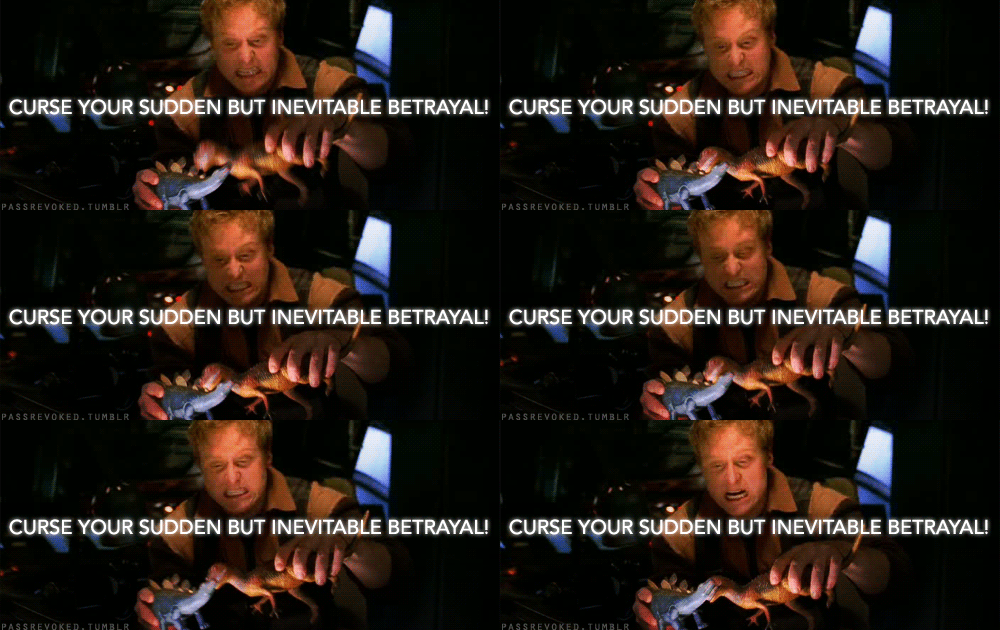
Curse Your Sudden, But Inevitable Betrayal


 Greetings Kittens,

For those of you who can’t place the reference, it’s Wash, from Firefly. And yes, I’m still bitter it was canceled. After all this time? Always. (Yes! I just successfully mixed fandoms in an absolutely relevant way, fellow geeks holla!)

I’ve given a lot of thought to this month’s theme of betrayal, and after going through all sorts of fictional and historic betrayals, I decided to blog about medical betrayal, specifically, when your own body betrays you.

I have Myalgic Encephalopathy/Chronic Fatigue Syndrome also known as Chronic Fatigue Immune Dysfunction Syndrome or ME/CFS and CFIDS, with Fibromyalgia Syndrome presentation. This causes disruptions in the central nervous system, immune system, neurological and endocrine system. My personal symptoms include insomnia and non-restorative sleep, IBS, concentration issues, daily headaches, sensitivity to noise, lights and touch, nausea, vertigo, muscle weakness and joint discomfort, widespread body aches, and bone deep fatigue.

Of the 17 to 20 million world wide who have ME/CFS, we each experience it a little differently. The thing that binds us, is the post-exertional neuroimmune exhaustion. That’s a catchy way of saying average physical or mental activity can wipe us out for hours, days, even weeks, depending on the severity of the individual illness. Some days, some months, I make it through. Other times like now, I miss a week of work because I’m in the bathroom every half hour, or I can’t sit up in a normal chair for more than a few minutes at a time.

Many feel ill and exhausted most days. A quarter of us are acutely disabled by ME/CFS, left wheelchair-bound or housebound, even bed-bound. ME/CFS can grow severe enough that even swallowing is no longer possible and patients must have feeding tubes. A 2011 study showed ME/CFS to have a mortality rate of 12.5%

The exact cause is unknown, but the onset has been linked to viral infections, immune dysfunctions, stress and even accidents. At the core, it appears to be an altered physiological response to bodily trauma brought on by illness, injury, stress or toxin exposure, that then damages the central nervous system and compromises immune function.

ME/CFS has no cure, and the treatment covers a wide variety of options from drugs to nutritional changes. That is, when you can get a doctor to treat you at all...

I was first diagnosed in 1992 and twenty-one years later there are still some doctors who don’t acknowledge it as real. This despite the fact that it has been studied and accepted by the World Health Organization, National Institute of Health, the CDC and FDA. Less than three weeks ago, the FDA met to discuss the efficacy of the first drug specifically for ME/CFS and the NIH is looking to increase clinical trials. All of the top medical organizations know what I’m going through, but I’m still struggling to find a doctor in my network.

Raised in the Western world, doctors are held up as the people with all the answers. It is a deep abiding sense of betrayal when they don’t even want to hear the question.

That said, there is still nothing quite like the unique betrayal of your own body holding you hostage, with little rhyme or reason. Some days I can dance and sing and have a wonderful time. Other days, just standing up can knock me flat. Foods that were fine on Monday, can leave me camped out in the bathroom on Wednesday. I can crank out a 15k novella one weekend, and be unable to concentrate for a full paragraph a week later. I’m open and full of hope and ready to take on the world at 12pm, and I need to go back to bed at 2pm. And I never know which day, which hour I’m having, until it’s there.

I lived a blessed few years in remission from 2005 to 2008, by 2010 I was in a down cycle, but pulling out of it. By 2011, I had fully crashed and I haven’t recovered since. I disappeared in 2012 because I didn’t have the energy to both work and do anything else at all. I couldn’t think, I couldn’t write, I couldn’t even chat with friends, it was all just too much.

I started slowly coming back from the isolation and withdrawal at beginning of the year, mustering up mental reserves and holding tight to the concept that I just need to make it a little further. That’s been working as far as interacting more, but physically, I’m still bouncing back and forth between making it through and falling apart. I’ve gone from feeling like I can come roaring back in 2013 in January, to realizing I may need to look at applying for disability in March.

Perhaps the deepest sense of betrayal comes from truly believing everything is going to be all right, while still having to live in a present where everything, is anything but...


There you have it, my current thoughts on betrayal, and a little insight on where I've been. 

Ramble Done, Kittens!

~X 


P.S. For more information on ME/CFS please follow the links below. If you think you might have ME/CFS CFIDS or Fibromyalgia Syndrome, please see your doctor and keep seeing doctors until someone helps you. If you know someone with ME/CFS, please spread awareness, it’s not “just being tired”, and we can’t “just feel better”. And if you just want a piece of advise for dealing with anyone you might encounter with ME/CFS, CFIDS or FMS, here’s a good one; never, ever say “but you don’t look sick".


08 March 2013

Betrayal... It's In Us


It’s In Us

The friend who muscles in on your boyfriend while you’re away. The family member spreading the secret he or she swore to take to the grave. Politicians caught with pants down or hands in the collective cookie jar. Back-stabbers, false smilers, sucker punchers.

We’ve all experienced it, or seen it. Read about it in the history books. Bought that rag magazine because of the headline, “The Nanny Stole my Husband!” Kept the channel on Dr. Phil’s show.

Betrayal.

Just the word gives us a shiver. It’s one of those impulses we’ve all had, occasionally perhaps succumbed to and can’t stop ourselves from watching unfold when it happens in our vicinity. Like the pictures of a train wreck or car crash. You want to be strong enough NOT to look, to show the strength of disapproval or the purity of your soul by looking away, but can’t. It’s such an integral part of the human condition it’s inescapable. Whether in the end you feel it was a good thing or a bad, can understand why the betrayer did what they did or not, it still leaves a fearful, distasteful sensation in the back of your throat. If Marcus Brutus, welcomed into Julius Caesar’s inner circle, given positions of power, regarded as a friend, could raise a hand to stab Caesar, what are those around us capable of? We shudder to think.

So we guard against and watch for it, always aware of the pain and destruction betrayal can cause. We restrain ourselves from giving in to the impulse to betray those around us—keeping the secrets no matter how juicy, biting our tongue when we could get others in trouble, turning away when tempted. Yet, on a deep, dangerous level, we often want to give in, to betray someone’s trust for our own gain or pleasure, or maybe even just for the fun of it…

We’re human. No matter how civilized we believe ourselves to be, it’s in us. We can’t help that, although we can keep it in check when necessary. So we do the next best thing to actually giving in—we read and write about it. Harmlessly get our fix of drama and danger through the pages of a book, even as we keep our eyes peeled for the real thing in our own lives. Putting the dagger in someone else’s hand, watching it rise and fall, yet knowing no real people were harmed in the bloodshed fulfills a basic human need—an atavistic desire to get what we want, to appear important, to do whatever we will with no one to tell us, “No.”

And, because most often we write or want to read about the betrayer getting his or her comeuppance, we fulfill another need by making them fail, get caught, pay for their betrayal in some way. We get our happy ending without having to succumb to another of those ugly, primal needs we all feel—the one that makes us want revenge.

04 March 2013

The Ides of March: Betrayal and Why We Love to Read (and Write) About It


This month we are going to be discussing betrayal in the stories that we write and read. Before we begin, I thought I’d talk about the Ides of March because I have to admit that I’d heard the expression but wasn’t real clear on its history. And I still haven’t seen the Clooney movie either.
Thank goodness for the internet.

The word “ides” comes from the Latin “idus”, which was used in the Roman calendar to depict the middle of the month. The Ides of March would therefore be March 15th. As a side note, this date used to be the day to celebrated and honor the god, Mars.
So where in the world did the idea of betrayal come from?

The 15th of March 44 B.C was the day Julius Caesar was stabbed to death by the Roman Senate. In his biography, Parallel Lives, the Greek historian Lucius Plutarchus wrote that a seer had warned Caesar that he would be harmed but no later than the Ides of March. While on his way to the Theatre of Pompey, the place where he was to be killed, a very much alive Caesar met the seer once again.
“The Ides of March have come,” Caesar said, clearly poking fun at the seer for prophesizing falsely.

The seer replied, “Aye, Caesar; but not gone.”
That night Caesar himself would be gone, murdered by a group of senators including his close friend, Marcus Junius Brutus. In modern times the phrase “You too, Brutus?” comes from the scene in William Shakespeare’s play, Julius Caesar (1599) where Caesar resisted his attackers until he recognized his dear friend in the mix. After after uttering the line, “Et tu, Brute?” he resigned himself to his fate and stopped struggling.

This ultimate betrayal by a friend has forevermore been linked to the Ides of March. And now we know.

Do you have any favorite betrayal stories?

For some reason, spy stories come to mind for me. Possibly because I just rented the new James Bond thriller, Skyfall. Without giving away too much, the theme in this action adventure is all about betrayal and the breaking of trust. If you haven't seen it, I highly recommend it.

www.kimberleytroutte.com