Showing posts with label characters. Show all posts

08 June 2014

Tossed Salad

Photo
Photo: WANA Commons, Lynn Kelley Author
According to our blog schedule, this month's theme is  LGBQT,so I sat down to write a blog. At first I thought I had nothing to say on this subject, except to be supportive of my fellow writers. I am a traditional woman/man, woman/werewolf, vampire/man, sort of writer. Those are the stories my muse tells me. Then I remembered something, I might not have heroes or heroines who fit the theme, but I do sometimes have more minor (but important) characters that do. I will admit, none of these manuscripts have yet to be published, but I have reason to believe that is about to change.
So why not heroes and heroines? No clue. As I said, those are the stories my muse tells me. And,  I suppose, what my audience expects at this point. So will my readers accept these minor characters who happen to be of a different sexual desire? I think so. My stories tend toward the theme of acceptance and finding one's place in the world. I would hope that whatever differences the characters within the stories my muse tells me have, my readers will be open to at least giving those characters a chance. In my—not so humble—opinion, our world is not that "melting pot" I've always heard about, but rather a salad. And really, what's more interesting, a pot of oatmeal, or a bright beautiful salad with all kinds of colorful fruits and vegetables?

Take care!
Cheryel
www.cheryelhutton.com

27 September 2012

Guilty Pleasures: My Secret Love Affair with Gibbs

"Should I call you Leroy?  Or Jethro?"

Pause.

"Gibbs it is, then."


What amazes me about this show is that the season premier this week had me on the edge of my couch cushions and it's the tenth season!  A crime drama centering around the Naval Criminal Investigative Service, it got its start as a spinoff of JAG, or Judge Advocate General, a military courtroom drama.

What sets NCIS apart, for me, is the strength of the writing and the rapport between the characters.  The shows from week to week aren't the same-old, same-old.  Each time we get a little glimpse into the lives of each of the people we've come to love and, unlike some other cop shows that I've enjoyed but then found to grow dull, we are kept interested by the development of those characters.  Tony Denozzo, for example, started out as a cad and has become a well-rounded man with a yearning for a real relationship but a fear of being hurt.  Each of the characters has matured and changed, evolved, if you will.

I find it useful to watch these kinds of shows because a) they have to tell a tight story in a specific time frame, which is good discipline for a storyteller and b) because they have to keep the audience engaged over time, even with the same characters.  That isn't easy to do and I think those of us who write in series can learn a lot from these shows.

And besides, am I the only one that has a crush on Gibbs?  Come on, ladies, 'fess up.  Who's your favorite?

30 August 2012

Characters, Part Deux

I have a second post in the month of August, which means I get to follow my previous post, "Gibbs vs. Longmire" with a discussion of memorable characters.


The earliest character I can think of is Odysseus, the protagonist in Homer's Iliad. Before Homer, of course, there are the Greek playwrights, but I don't know their characters nearly as well.  I think the Iliad and the Odyssey have the greatest public recognition, particularly since Hollywood has taken an interest in them over the years.

Last year, Sela Carsen wrote a great article about mythology, in which she talks about the ancient gods and goddesses as sources of ideas for stories.  Before classical literature, stories were told of these beings and their trials and tribulations as they mirrored, and reflected back to humanity, peoples' behavior.

I think that's the point of telling stories, in many ways.  We tell stories about ourselves, to ourselves, in an effort to better understand the world around us and the people with whom we must get along.  People are confusing and stories help us make our way through the pitfalls that inevitably arise whenever more than one person gathers together or tries to accomplish something.


Then along came William Shakespeare.  Practically single-handedly, the playwright changed the face of English letters and, with it, the society and times in which they existed.  Whether or not he was one man or, as some argue, multiple people, the influence of the plays of Shakespeare is inarguable.  Romeo and Juliet, Hamlet, and Henry the Fifth are some of history's greatest characters - memorable and lasting.  Though he wrote centuries ago, his plays are still performed, his characters are still in the public consciousness, and his stories are still relevant.

Will our modern-day poets and playwrights craft as memorable material?  Will Stars Wars still screen three hundred years from now, and Buffy the Vampire Slayer be part of the Canon?  I don't know, and no one living now does know what the future will bring.  But it's interesting to wonder whether the likes of George Lucas, Joss Whedon, and Peter Jackson will, one day, join the ranks of Homer and Shakespeare.  What do you think?

02 August 2012

Gibbs vs. Longmire

Our theme for the month centers around characters and threw me straight into the horns of a dilemma.  Who is my favorite character on television right now, Gibbs or Longmire?


Well, let's see.  Mark Harmon plays Gibbs as quiet, reserved, dedicated, intense.  Robert Taylor plays Longmire as quiet, reserved, dedicated, intense.


I guess it's a good thing they're not on television at the same time.  NCIS was voted "America's Favorite TV Show" and has just been renewed for the 10th season starting September 25, 2012.  (Wikipedia article "NCIS", accessed 08/01/2012.)  It airs on Tuesdays nights on CBS.  Longmire is a new show on A&E and airs on Sunday nights; episodes are available on the A&E website.  

Shows that I really love (Firefly, Dollhouse, Alcatraz) don't seem to stay around on television very long.  It's rare that I fall in love with a "popular" show (I loathed Seinfeld, for example).  I'm pleased that NCIS is being renewed and am enjoying going through the episodes through Netflix.  The season finale of last season was a doozie (I won't type the spoiler here, but fans who saw it will be with me when I say I'm on the edge of my seat to find out what happens).  

Longmire is a little different.  It centers around a small-town sheriff who lost his wife and his focus, but is now getting the focus back.  Set in rural Wyoming, it involves the local Cheyenne tribe as well as encroaching Mexican drug cartels and Amish families.  I like its twist on the traditional police procedural and how it portrays different cultures with a penetrating and more realistic eye than I've seen done previously.

What about you?  What's your favorite characters to watch this season?

28 August 2011

Superheroes and why we love them!

It's been a great summer for me and anyone who loves superheroes – and plenty of characters to fall in love all over again or for the first time. But why do we love the good guys who are so often the bad boys? Here's my thoughts!

Tony Stark – Iron Man


Okay, I know Iron Man 2 was released last year but I love Robert Downey Jr. too much to not include him on this list. It wasn't such a great year for Tony on the business front – but he went places on the personal battleground with Pepper Potts! Why do we love Tony despite his character flaws… being a borderline alcoholic, workaholic, egomaniac and smug beyond belief? Because he's such a bad boy… in hot rod red!

I'll also add Sherlock Holmes into this mix because Downey plays him so well – who wouldn't want this great detective to unravel your mysteries? The man who can figure out almost anything doesn't seem to know a whole lot about women – but there's a lineup waiting to teach him!

*snickers*


Let's move on to a real God… Thor! Rocking the silver screen this summer with his big hammer, the Norse God of Thunder made the earth move with his abs and his wonderful boyish charm – tamed by Jane Foster who brought him down to ground and taught him that Earth Girls are… Fun!


Green Lantern - now there’s a man you can’t help but love. Able to create anything he can think of using his green ring? Hmm…. the possibilities! But for a man who can do anything he can’t face up to Carol Ferris and tell her how he feels about her and make a commitment… until he finds the strength inside to do what he needs to do to save her and the world!


My own lovely Canadian, Wolverine! Okay, so he might have a bit of a problem with facial hair and nightmares but he’ll always be there to scratch those hard-to-reach spots on your back! He’s still looking for the right woman to settle down with after having his heart broken a few times but who can’t love a cigar-smoking, beer-drinking man!


And last, but never least, our own Captain America! Poor little Steve Rogers never had any luck with the girls until he got the super-soldier serum… then women couldn't keep their hands off of him! Good thing Peggy Carter is there to not only help him fight off the women but also to keep him close and safe! I must admit the best scene for me is where poor old Steve doesn't quite understand the meaning of the word "fondue" and has to have Howard Stark (yes, Tony's dad!) explain girls to him. Be afraid, be very afraid.


Anyone have any more superheroes to add? I bet there's quite a few more to add to the list…

25 August 2011

Characters First?

Hi everyone,

I'm a new blogger here at Beyond the Veil! My name is Leslie Dicken and write paranormals, fantasy and historicals (gothic and steampunk). Guess I can't settle on just one subgenre! But one thing is the same no matter what type of story I'm writing: plot comes first.

I'm supposed to write about specific characters, ones I love or hate, but I'd rather talk about how creating characters comes SECOND when I'm brainstorming a story.

I hear over and over again how authors come up with their characters...THEN they figure out the plot or storyline that works for that character. I heard that J.K. Rowling came up with Harry Potter, the character, while on a train ride. She didn't think of Hogwarts or the Sorcerer's Stone, but of the boy who was a wizard and lived with his muggle aunt and uncle.

As for me? I first have an idea of a story or theme or a plot. For example, I wanted to write about a hero who learns he is not an earl, but a bastard (A TARNISHED HEART). Or an alien who dislikes humans but must find one to help his home planet (THE PRICE OF DISCOVERY). Or a society where two cultures have lived apart from one another for so long, they've evolved differently (TABOO). An isolated manor with a hero who thinks he's committed murder (BEAUTY TEMPTS THE BEAST). I've even just wanted to combine various subgenres into one story: steampunk, historical, suspense (THE IRON HEART, Feb 2012).

None of them started with the idea of central character who needed to find a story. They all started with an idea...a plot or theme or just a challenge to myself.

Hopefully, the characters I created for these stories are just as well-developed as those authors who start with character first. :-)

If you're an author, which do you come up with first: character or plot?
As a reader, what makes you feel a connection with a character in a story?

22 August 2011

The Tortured Hero

I am loving this month's theme on characters. Very interesting to see all the hero favs.

For me, I love the tortured hero.

You know the one, he is honor-bound by reponsibility, family, justice. He marches into battle to protect the ones he loves. He jumps in front of a speeding train to save a child, even though he will never see his own baby, or wife again. He loves with his whole heart knowing that in the end he will do what he has to do, even if it rips that heart out.

Heavy sigh.

Cain in Soul Stealer is one of my tortured characters.

His job as Death is to stand sentry as a living soul shreds from a person's body. Cain lives forever, cursed to watch as all the people he ever loved die and go to a better place without him.

His job sucks.

He performs it willingly because:
a) someone has to and
b) he sees it as punishment for the crime he committed at the dawn of time.

He plans on doing his job with dignity and compassion until the end of time.

Until one woman changes all plans. Death shouldn't fall in love with the dying. Should he?

But this is what's great about tortured heroes: they are doomed to living a troubled existence unless a special woman turns things around. She takes away the torture and makes life sweet. Love always wins.

Another heavy sigh.

Santiago, in Catch Me in Castile, has his own torture to deal with. He has his hands full protecting his sister from a dark curse and his family from a very modern-day psychotic killer. There is no way in all holy heck that he should he fall in love, even if Erin makes him happy for the first time in years. No, he needs to push her away to protect her life.
He needs to step back. So why can't he let her go?

Because best laid plans don't always work out when love is involved, do they?

Santiago is so busy saving everyone else, he doesn't realize that he needs saving. Love is the only cure. And that is sigh-worthy.

Do you love tortured heroes?

Thanks for reading!
Kimberley Troutte

www.kimberleytroutte.com

20 August 2011

Characters - Write what you know?

People who know I'm an author often ask what parts of myself I put into my characters. People who know me well want to know why I'm not trying to sell my life story to Lifetime. *grins*

I'm a product of the foster care system. In a lot of ways, my life does read like a Lifetime movie. It's one of the reasons I write Paranormal Romances. I have always written to escape my reality, not embrace it. Having said that, it's impossible for my past not to bleed into my work.

When the concept for the Ladies of St. George popped into my head, I initially shelved it. I thought the idea of a bunch of damaged heroines wouldn't make good romances. And then I heard Destiny. After writing the opening scene, I talked to a friend about my concerns. Her answer? Write what you know. One of the reasons Bella is so engaging is that she's real.

So, I did. I took all the isolation, anxiety, and personal backstory into the St. George world. You see, I know what it's like to live life without a safety net; to know that every decision, good or bad, will have irrevocable consequences. I never had anyone to bail me out if I made a wrong move. In college, I worked two, sometimes three, jobs to make ends meet because not earning that degree simply wasn't an option. I had nowhere to go and no marketable skills without it. At a college filled with silver-spooners, it was hard to watch my fellow students squander Mommy and Daddy's money because they didn't care.

But I carried more than that into my St. George heroines. I don't make friends easily. Growing up, the one thing foster homes and abusive homes have in common is that friendships are discouraged. In abusive homes, it's to keep the abuse hidden. In foster homes, it's to ensure a smooth turn-over when it's time to move on to the next one, usually after you cross an age milestone or when your usefulness has ended. That teaches you to be fiercely loyal to those you have the opportunity to grow close to and to hold onto those fragile bonds as long as you possibly can.

Another thing the St. George heroines have in common is the way they value simple things. I never had a milestone celebrated: birthdays, graduations, personal accomplishments, etc. Anything that involved being valued? I was left out in the cold. The only value a foster child has is the rent they bring in. What it taught me was that small things matter, especially those that require personal attention to details.

What I like about my Ladies of St. George series is that I can fold up all the bad parts of my life and spin it into a story where all the weaknesses become strengths and there is always a happy ending.

In BLOOD AND DESTINY, I hear a lot about Yasmine and Destiny with their different life paths. When I introduced Grace in CHRISTMAS GRACE, my inbox was flooded with notes asking about her backstory.

I'm glad people like the St. George heroines because they aren't a mirror of my own life experiences. I'm not using myself as their model. I'm writing stories about how circumstances beyond our youthful control turn us into the women we are as adults. What's cool about that is how each personality morphs the same isolating childhood into a productive life. And how they turn those needs toward the men they chose to share their life with. Yasmine turned hers into a need to create a family, to give to her child the loving home she never had, and that lead her to Kale, alpha family man. Destiny flipped the other switch and became afraid of commitment, of being thrown away when her usefulness was over. So, Destiny fell in love with a vampire who would not only outlive her, but couldn't understand monogamy. Grace turned her demons into the need to put herself first. After all, if she's not going to look out for her interests, no one else is going to care enough to do it for her.

And for you? What parts of your personal backstory lead you down the road you traveled? What part of your own deep needs can you pinpoint to an incident in your past? Me? Well, the reason Yasmine doesn't have a book is because I share her needs. After having a childhood where there were no celebrations, I wanted to give my children everything I had been denied. So far, I'm doing all right.

15 August 2011

Odd, Quirky, and Off The Wall--Like Me!

The dirty little secret is that I’m not the one who tells the stories. The truth is that I’m the typist. The real crafters of my stories are my characters. But then, I’m attracted to characters. I love watching odd people, or people doing odd things, in real life and in movies and on TV. I hope to capture some of that oddity when I write my stories.


One of my all time favorite is the baby from the TV show Dinosaurs. Baby and his family still make me smile, and the depth of the storylines, hidden under the cute surface, amazed me. It was truly a show for all ages.


Who doesn’t like the TV show Monk? The strange and wonderful Adrian Monk is a pleasure to watch. The actor, Tony Shalhoub, studied people who have obsessive-compulsive disorder and translated the reality into an over the top, quirky character.


I’m not much of a reality TV girl, but I make an exception in the case of Pitboss. There are dogs, okay? The cast of Pitboss: Shorty, Ashley, Sebastian, and Ronald (plus the dogs!) are the quirkiest, most fun group of folks on the little screen. I will warn you, is there is some foul language, though most of it is bleeped out.

There are many other wonderful characters on TV, movies, the mall, and, of course, in books. Who are some of your favorites? What makes a character memorable? Have you ever done something just because it was odd?

Happy Monday, and have a great week!

Cheryel
www.cheryelhutton.com


13 August 2011


I was a rotten kid. As a child I loved to torment my brothers and boss around the other kids on my block. As a result, I didn’t have many friends. (Yeah, I know. Sad, but I deserved it.)

That’s when I started making up my imaginary playmates. My first playmate was a boy named Larry. I adored Larry and took him everywhere I went. He would sleep in the imaginary bed across from mine. He would sit next to me at the dinner table. Heck, he even played softball, standing right next to me, although he was never a very good player.

Best of all, Larry was as rotten as I was. Larry was the culprit whenever my hand developed a mind of its own and thumped my brother in the head. Larry took the blame whenever I “accidentally” bumped a bowl full of vegetables off the table to scatter awful-tasting peas across the floor. Larry was with me, egging me on when I dropped water balloons off the roof onto unsuspecting neighbors. Larry was the one who made me stay up late and miss the school bus. Larry was, for all the wrong reasons, the perfect playmate.

Then I grew up and Larry went away. Or did he?

I love writing all the characters in my books, both good and bad. Heroes and heroines alike find a place in my heart. But I have to admit that the bad boys claim a special corner. Why? Perhaps it’s because each of my bad boys, whether or not they turn out to be the villain or the hero, has a part of Larry in him.

For instance, the three Cannon brothers in my Cannon Pack werewolf series are different, but they all have a bit of Larry thrown into their personalities. Jason Cannon has Larry’s uninhibited streak. Devlin Cannon has Larry’s witty sarcasm and Daniel Cannon is the guy who acts more calloused than he really is. In my latest book, CLAWED (Wild Things, Book 3), Conan is a bear (literally) of a man who takes on Larry’s habit of one-word answers. Like Larry, he’s stoic, aloof and sometimes downright rude. But in the end, Conan─again like Larry─will do anything for his girl.

So you see, Larry continues to live. Sure, he went away while I grew up and developed other interests. But when I wanted him again, when I became a writer and needed a bad boy, Larry came back to stay.

Now here’s the question for you. Since most of us have had an imaginary friend at one time or another, does your friend still live on in you? Is your friend by your side whenever you shake your head and answer, “I don’t know who did it”? If no, don’t you wish you had your imaginary friend back in your life?

10 August 2011

13 Links about Characters and Characterization

This month at Beyond the Veil we've been posting about characters. Here's a quick round-up:

1) We started out with Xakara talking about Character Crushes (http://paranormalauthors.blogspot.com/2011/08/characters-welcome-and-readers-too.html)  and she kindly included photos of Michael Shanks, Vin Diesel and Nathan Fillion.

2) Then from A. Catherine Noon, we had an analysis of characters from several science fiction franchises (http://paranormalauthors.blogspot.com/2011/08/characters-i-love.html).

3) Sela Carsen ackled mythological characters (http://paranormalauthors.blogspot.com/2011/08/characters-from-mythology.html)  and archetypes, encouraging us to look around as less common mythologies for story research.

4) Characters who cause conflicting emotions (http://paranormalauthors.blogspot.com/2011/08/characters-you-love-to-hateor-hate-to.html)  were the topic of Carolan Ivey's post--a prime example being Severus Snape from the Harry Potter series.

5) Amy/AC Ruttan talked to us a little bit about a favorite historical character, Boudicca (http://paranormalauthors.blogspot.com/2011/08/most-memorable.html),  the spelling of which I had to check several times because nothing looked right.

6) Bianca D'Arc talked about how she is turning HERSELF into a steampunk character (http://paranormalauthors.blogspot.com/2011/08/convention-time-again.html)  for a conference.

7) I am going to continue the listmania I've already started by sharing some links to writerly articles about characterization or characters. First, from my own blog, here is the first entry that came up when I typed in characterization that wasn't one of Meankitty's interviews: http://blog.jodywallace.com/2011/06/whats-up-with-larry.html  This short article is an examination of the character of "Larry" from the Young MC song "Bust A Move". Yes, characterization can occur in works of fiction as short as songs and poems! Let's just say it's succinct characterization (as long as you're not J. Alfred Prufrock).

8) Here's some tips about making character's lovable: http://www.netplaces.com/writing-a-romance-novel/the-nuts-and-bolts-of-characterization/making-characters-lovable.htm

9) Here is a list of deaf characters in romantic fiction: http://www.myshelf.com/deaf/romance.htm  which is more than a little awesome.

10) Author Gabi Stevens talks about writing romance novel protagonists: http://gabistevens.blogspot.com/2009/09/how-to-write-romance-novel-characters.html

11) A slightly older essay from Jennie Crusie about learning tricks from television to use in your romance fiction, including for characterization: http://www.jennycrusie.com/for-writers/essays/the-five-things-ive-learned-about-writing-romance-from-tv/

12) For some snarkier fun (yes, snarkier than Crusie!), here's a look at historical male character (stereotypes) from a website called Literary Dilettantes: http://literarydilettantes.com/2011/03/15/deconstructing-the-romance-novel-characters-edition-part-2/

13) Last but not least -- because (nearly) every character needs a name, here's some character naming tips from Anne Marble with a special section for speculative romance authors: http://www.writing-world.com/romance/names.shtml

It's in character for me to do a Thursday Thirteen at the last minute but I'm actually posting this on Wednesday night! That's slightly OOC (editorial shorthand for out of character) for me but I put not one but 3 reminders on my computer this week so I wouldn’t forget.

Happy reading!

Jody Wallace
So much cyberspace, so little time!
www.jodywallace.com  / www.meankitty.com

07 August 2011

Most Memorable


So I’m super excited to be a part of the Beyond the Veil. My name is A.C. Ruttan or Amy Ruttan. I go by both. A.C. writes dark and not really overly romantic and Amy writes a bit more…spicy. Both write paranormal.

I thought I would talk a bit about one of my favourite characters from history, Boudicca and how she came to be my most memorable character.


The first time I became ‘aware’ of Boudicca was after reading Pauline Gedge’s The Eagle and the Raven. I was totally entranced and I went on a binge about trying to learn as much as I could about Boudicca of the Iceni.

It’s not mystery to anyone who knows me, I am a history nut.

So when I was writing my first urban fantasy, my heroine Cia had a dual personality in the form of two souls and one of those souls was Boudicca, queen of the ancient Britons. I wasn’t expecting her to be Boudicca of the Iceni.

I kind of had to a double take when she walked fully formed into my mind carrying a big broadsword.

I had this picture of the heroine and sort of what she wanted to do which was kill demons. Lots of demons, I just hadn’t counted on the two souls thing and one of those souls being Boudicca.

Cia’s older soul was crass, opinionated, strong willed and so very angry about what happened to her on the battle field. My heroine’s calm persona, or newer soul, was the great foil of tempestuous Boudicca.

Not that I personally know that Boudicca was tempestuous, but given the legends surrounding her and the fact she took on the Roman Legion to avenge her people and her loved ones and faced certain death you have to think she has a lot of ANGER issues.

Here’s what I mean:

“You should let your souls combine and merge. Let her loose—you fight her too much. It was always part of your problem.”

“Arthur,” I said, very calmly, “my two souls are very different from each other. My newer soul is very level-headed and peaceful. It is the way I prefer to be. My older soul is a vengeful warrior woman. If I let her out she would take over and seek retribution.”

“You are correct in your assumption.”

She is my most memorable character and my most frustrating. She still is one of my most frustrating characters (because I’m writing the sequel).

In writing Incarnate I was able to combine my love of history and the paranormal and as it was my debut urban fantasy I had to show off my favourite historical character. Of course, it’s not like I had much of a choice in the matter. She was quite insistent.

It was also my first attempt at writing first person. I may have published a first person POV before Incarnate came out, but Incarnate was the first I wrote in first person.

It was like Boudicca needed a voice. She also had the urge to kill demons with swords. She quite likes that bit.

“Michael thought you might be needing it so I flew myself to Yellowknife and retrieved it.”

“Thank the goddess.”

A smile curled my lips as I grasped the hilt of my sword. My blood heated as I held the iron in my fist—the intricate designs glinting in the dim light of Damien’s hall. I always missed it when I left it behind.

“I slew many a Roman pig with this sword, as well as a few demons.”

So, do you have a character you’ve read or written, one that just sticks with you and won’t leave you alone? Do you have a character who has entrenched themselves so deep in your soul that you’ll never want to be rid of them?


A.C. Ruttan

http://www.acruttan.com/

06 August 2011

Characters you love to hate...or hate to love?

In my first completed manuscript (which is still growing mold in some long-forgotten drawer) my focus was so ferociously on the hero & heroine that the antagonists didn’t even make an appearance. They were just some faceless entities that had, for no apparent reason other than that They Were Evil, scarred the protagonists’ careers, psyches, and lives in general.


My second manuscript, Beaudry’s Ghost, had a bad guy on stage, even a scene from his POV. Confederate Lt. Zachariah Harris was one of those gleefully vicious, vindictive villains that seemed easy-—too frighteningly easy-—to write. (Did I just use three “v” words in a row??) All he had to do was wield sharp objects and attempt to kill the hero in the end.


Third time around with A Ghost of a Chance, I went with a more insidious villain with a subtler technique for working his evil-doings. A method that, in real life, too often sucks otherwise intelligent women into bad relationships. (Aside: How funny that in a book full of concepts like astral travel and all manner of psychic phenomena and sexy shapeshifters, one reviewer zeroed in on this villain as the least believable part of the story! But that’s fodder for another post.)


Creating three-dimensional heroes and heroines seems to come much easier to me. I’m still working on developing equally rounded villains. Not too long ago I was surprised to learn even the great Stephen Spielberg looks back at “Raiders of the Lost Ark” with pangs of regret. After completing his masterpiece “Schindler’s List”, he said something to the affect that in comparison, the bad guys in “Raiders” were ridiculously cartoonish, almost to the point of being an insult to those who suffered an died at the hands of the Nazis. By the time “Last Crusade” hit the screens, he’d given at least one or two of the Nazi characters some depth.


George Lucas, as well, spent three entire Star Wars movies making us fall in love with Anakin Skywalker before he vanished behind Darth Vader’s helmet. Did it change the way you watched Luke Skywalker's story arc? It did for me.


It’s fascinating to know that everyone, even the best of us, goes through a learning curve.


When I think about it, the stories I like best are the ones that make me ambivalent about wholeheartedly hating the villain. After all, no one is born inherently bad. At some point, he or she was someone’s child, grandchild, brother or sister…maybe even a mother or father. As a writer I think it’s my job to bring all those factors into play when creating a character, even the ones who—-for the purposes of that particular story—-were born to be bad. :)


Can you think of characters, evil or otherwise, in a book you’ve read or a movie you’ve seen that leave you waffling over whether to hate or love them? Or who came back as a hero in a sequel? Here are a couple of mine:
  • Jimmy Angelov in “Practical Magic” (okay, only because Goran Visnjic is freakin’ HOT!)
  • V in “V for Vendetta” – Hero or psychopath?
  • Ilsa in “Indiana Jones and the Last Crusade”
  • Walter White in “Breaking Bad”
  • Severus Snape in the Harry Potter books/movies. Whose heart didn't break for him when we learned his real motivation? (Mine did, and Alan Rickman's on-screen interpretation brought tears to my eyes.)
Love to hear your thoughts!


Carolan
www.carolanivey.com

05 August 2011

Characters from Mythology

Lucky is the author for whom characters spring fully formed from her imagination and onto the page, much like Athena from the head of Zeus.

Alas, I am no Zeus. Therefore, creating a character for me takes good old fashioned mortal, mental and mythological elbow grease.

Mythology provided archetypes of characters for millennia before Joseph Campbell came along. The Alpha Male, the Nurturing Female, the Brooding Loner, the Kick-Ass Chick -- there's nothing new under the sun.

But myths don't only provide the characters, they can also provide some framework for a story - ways to develop your characters into something more than archetypes. How many ways has Hades been transformed into the Beast who steals Persephone/Beauty from the love and light of her family? In the hands of a skilled storyteller, he's more than a distant immortal, an ideal from far away. He's a man in unending, soul-searing agony until he sees the one being who can give him surcease from his pain and loneliness.

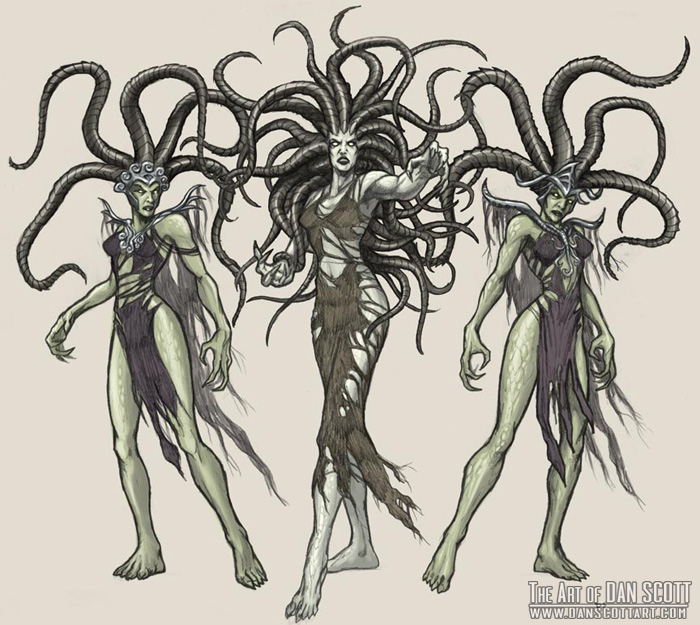
Sometimes, the myths are half-told. They give us a hint of a character or of a story and it's up to us to flesh out those few drops of inspiration. For instance, there are three Gorgons, but we only ever hear of Medusa. In fact, she wasn't even a proper Gorgon - she was a mortal woman cursed into that form by Athena. So what about the other two? Stheno and Euryale? What's their story?

When you're using an archetypal character, it helps to be able to see as big a picture of that character as possible. To go back to Medusa, it wasn't enough to simply see her as a monster with snakes on her head. I needed to know the myth inside and out. That's how I discovered that she was created by Athena for fooling around with Poseidon in Athena's temple. But that still wasn't enough, so I went back to the Gorgons. Why make her a Gorgon? They were protectors, meant to inspire terror in the enemies of the Olympians. In fact, Zeus put the aspect of the Gorgon on his shield, using the image of a power older than Classical Greece to reinforce his own power.

Older than Greek? Okay. I looked up ancient snake goddesses and snake symbolism. Ladon the serpent protected the golden apples of the Hesperides. Blood taken from Medusa's right side was made into a healing potion by Aesclepius. A snake is wound into a symbol of healing in the Rod of Aesclepius. Moses formed a copper snake and twined it around a pole to heal the Israelites. Snakes were regarded as wise and cunning and could even gift people with second sight. Wisdom? Healing? Protection? The worship of a chthonic (earth-based) serpent deity had as many positive notes as it did negative.

Suddenly, there's more to Medusa than a raging bad hair day. There's a character there. Not as neat and tidy as Athena from the head of Zeus, but a character formed from mythology, nonetheless, and with possibilities for theme and symbolism already built in.

So when you look to archetypes and ancient tales to build a story, be sure to cast your net wide. You'll pull in more than you dreamed!

Sela Carsen

04 August 2011

Characters I Love

When I saw Star Wars at the age of nine in the theater (or maybe it was The Empire Strikes Back), I had a HUGE crush on Luke Skywalker. Dashing, attractive, daring, he was everything I wanted my hero to be.


Remember the scene in the first part of Star Wars, where they show the two ships fighting the lasers go whizzing past with lots of loud noise?


I hid in my dad’s shirt when that happened.

I also hid when Darth Vader and Luke fought the first time, and when Luke lost his hand. How I hated Darth Vader! That breathing!


I remember a few years back that modern audiences don’t find Darth Vader scary at all, but that the new set of Star Wars movies had Darth Maul as the new big-bad.


Say what?? How could you not find that breathing scary?

Then I saw Space Balls (somehow I missed it when it first came out). Not at all scary, and I tried to tell myself I agreed – Darth Vader isn’t scary.


But I still shiver when I think of him, and that awful breathing.

I didn’t have imaginary friends growing up. Instead, I told myself stories, and others too. I wrote the first one when I was nine; an embarrassing-to-me-now piece about a cat named Marge.

Hey, we all gotta start somewhere, right?

Then I discovered Star Trek on re-runs. I used to watch it on my parents’ old black-and-white TV in their bedroom while my mom was in some other part of the house, sewing or cleaning or what-all. The shows captivated me. I wanted Captain Kirk to be my dad. Or at least an uncle.

Then came the alien probe episode.


I’m sure, if I watched it now, I would find it quite unscary. After all, we’ve progressed light-years from the olden days of special effects. But that probe episode sticks with me, for the sheer dread I felt while watching it. There were a couple others that I found equally riveting, and that had characters that scared me. But the idea of a machine attacking people, to me at the time, inexorable.

Somehow, the Terminator must have gotten my brain scans, because they couldn’t have conceived of a scarier redux on that idea! I mean, it’s a machine, shaped like a man! It could be anyone! Schwarzenegger’s gotten a lot of bad press lately, much of it self-inflicted, but he will forever have my admiration for the portrayal of that heartless, soulless machine in the first movie. Not to mention, he was unstoppable! I know everyone remembers the “Ah’ll be bahk” quotes. But to me, the seminal moment is when the terminator is crushed in the machine and STILL keeps coming, even without his legs working.


Yikes!

I remember reading a quote attributed to Lois McMaster Bujold relative to her character, Miles Vorkosigan. She said something along the lines that she simply imagines what horrible tortures she can do to Miles, and then figures out a way for him to surmount them, and that’s how she comes up with her stories. In the process, she’s created one of the most amazing characters of science fiction. Here is a man who is crippled, maimed, and some might say, deformed. Yet he manages through sheer force of personality to abscond with a mercenary army and then return to take command of that army – despite not being of legal age to drink.


For me, what makes characters, good or bad, memorable is how they handle the consequences of their actions or the actions around them. It isn’t enough to just do “stuff” to a person. What’s interesting is how that person responds to it. I remember my father ranting about the movie The Perfect Storm, because the men upon whom the story is based were drunk and stupid. He felt that was no way to tell a story, since the people involved had no redeeming characteristics. I didn’t quite know what he meant until I saw the remake of The War of the Worlds. Tom Cruise’s character was awful! The portrayal wasn’t bad, as Mr. Cruise is a skilled professional. But the man he portrayed was, to put it bluntly, a waste of time. He didn’t stay with his wife, was a neglectful father, and a coward. Yet the entire movie revolved around him as though he was some sort of reflection of everyman, a modern-day hero.

To that I say, poo. I want heroes like Luke Skywalker. Men and women who take what is given to them and turn it into something grand. Villains who intimidate by a look or a gesture.

Characters, in short, who make me believe, even for only a short while, that they are real, that they live and breathe, and that I could one day meet them.

~A. Catherine Noon

12 February 2011

The Name Game

My new story and I have reached an awkward stage in our relationship.

I know what the story’s about: a naïve aspiring reporter helps an enigmatic sorcerer use the magic of Washington, DC, to take down a corrupt politician. I’m desperately in love with the setting. How can you not get all tingly at the prospect of writing a story set in a world capital crammed with historically charged relics and quasi-magical objects where there’s a pentacle set right into the street grid? And it’s my hometown. I love my hero and heroine, and I loathe my villains. But I don’t know who they are, and being a dyed-in-the-wool plotter, I can’t write about them until I do.

Wait a minute, you say, didn’t I just claim to love my characters? I did. I do. But I don’t know their names.

This happens to me a lot. Most of my stories start as a visual—a single scene or a character. It erupts like a camera flash in a darkened room, imprinting its image on my retina for a long time afterwards. Usually, however, that image is all I’ve got. I have to prod it with hot pokers to tease out the details. Sometimes I can see the character and his or her back story in cinematic detail, and still have no clue to his or her name.

It isn’t always that bad. Every so often, the character walks up and introduces him- or herself. Earlier this month, I submitted a story to an anthology focused on 21st century fae. Because I’m warped, I decided to write about a half-human cat sidhe trying to avoid getting neutered when he’s taken to his local animal shelter.

The obvious name for a male cat in that predicament would be Tom, but my guy said no way. His long-absent cat sidhe father was a Tom, Tom Tibbert—presumably related to Tibert (or Tybalt), the cat who often ran afoul of Reynard the Fox in medieval folklore, and whose hot-blooded character may have been an inspiration for his namesake in Romeo and Juliet. Instead, my hero called himself Jack, a name as far away from his feline heritage as he could get. The name of his Daoine Sidhe nemesis, who figured out how to become a veterinarian in spite of a serious iron allergy, came just as easily: Cait Kellas, the wild Kellas Cat of Celtic mythology. But Jack’s helpfulness didn’t end there, he even told me the title of the story, “Fixed”.

Personally, I think he was scared of his heroine, an awesomely competent young woman whose name loosely translates into “She who must be obeyed”. The process by which she acquired her name is typical for my human characters.

This character arrived brandishing a healthy chunk of back story. I knew her age—sixteen as of the projected publication date of the story. There was also a good reason why she had to be Japanese American. With these facts in hand, I went to Wikipedia and pulled up their list of popular Japanese actresses, looking for first names which would work in both cultures. I discovered “Erika” and its diminutive “Rika” were popular in Japan. In addition, according to the Social Security Administration, “Erica” was among the Top 100 U.S. Girls’ Names for 1996, the year my character would’ve been born (if you take book production cycles into consideration). An added plus was the name’s meaning: always ruler.

My character liked Rika. It was modern, a little bit edgy, and the meaning really fit her take-charge personality. Having a name meaning that reflects a character personality or appearance isn’t essential for me. In some cases, it can actually be a turn-off. But when it works, I let it.

Next came her surname. While I was trolling the list of Japanese actresses for first names, I was jotting down last names that were easy to say but didn’t have any associations that might interfere with my depiction of the character. For example, Tanaka is one of the most common family names in Japan. But I can’t see it without recalling “Tiger Tanaka” in the James Bond novel and movie You Only Live Twice. Chances are if the association is that powerful for me, it would get in the way of my readers, too.

To my preliminary list of actresses’ last names, I added the entries in the Wikipedia list of most common Japanese family names and the comments on Wikipedia’s Japanese name page. Finally, I reached the point I call the Spaghetti Test. I started throwing various last names at Erika/Rika to see which one stuck. Ultimately, we—I mean, I decided on Erika (Rika) Nakamura, because it sounded good.

To name a villain, I’d go through an additional step: searching on the name to see if it happens to belong to anybody famous, or at least famous enough to end up in Wikipedia. I prefer not to name my villains after real people. It’s just mean. But I really, really don’t want to give a villain the name of an under assistant secretary of something in the 1980s, especially not a villain who happens to be a politician. The individual in question might think it was personal.

Most people don’t mind having a hero named after them, but for the sorcerer I’m writing about now, that could get real dicey. I can’t use another character to intimidate him either. He’s the avatar of a god, and he knows it, dagnabbit.

Quasi-divine characters are (ahem) hell to name. You want a name that conveys both authority and mystery—and doesn’t make your readers spew cola out their noses the first time they say it aloud.

Some writers express a character’s magical potency and charisma by misspelling inherently powerful words, like “reign” or “wrath” or “lust”. I can’t. The very notion makes my inner pedant cringe. Of course, I wince when I hear people say “imply” when they mean “infer”, and “disinterested” instead of “indifferent”, so what do I know?

Another popular tack is to use the common archangel names: Michael, Gabriel or Raphael. I might resort to that if my sorcerer continues to play coy, but it’s a bit cliché. I’d prefer to give him an ordinary name that’s strong, fairly common and yet fitting. Names are an important tool for creating a character’s image in the reader’s mind. They are also self-fulfilling prophecies. I couldn’t name this guy Dick, even as a temporary measure, because sure as shooting, he’d start acting like one. That’s just how my mind works. To make matters worse, the son-of-a-gun told me which god he incarnates. Suddenly, there are whole categories of names I simply can’t use, unless I want to make him really mad, which is something I absolutely, positively don’t want to do.

At least, not at this point in our relationship. We’ll get there eventually. One of the eternal truths of writing is, sooner or later, your characters will hate you for the very things you do for their own good. They’re like children that way, or pets on the way to the vet.

Meanwhile, I’ll just keep throwing names at my sorcerer and see if any of them stick. Without a preselected list of candidates, the Spaghetti Test is a slow, random process.

And it leaves my dashing, enigmatic, nearly divine hero covered in spaghetti. Score!

10 January 2011

I'm in Love...with my manuscript

I'm writing a new book. No surprise there, I'm always writing a book. What's thrilling is that I find myself head-over-heels in love with it.

Okay, I know that sounds, well, weird.

But here's the thing, writing a book is hard. Pretty much everyone agrees with me on that point. It's logging endless butt hours at the computer, researching, plotting, planning, organizing, cutting, scouring baby books for that perfect sounding hero name, looking up words that mean the same thing as "look" without saying "look" a million times, thinking hard, burning a few meals, not answering the phone, not shaving your legs, cutting the papertowels into teensy squares so that the kids have napkins in their lunches because oh my gosh who has time to go to the store for napkins, dreaming dialogue, pulling hair out, whining, whining, whining...

And then...a miracle happens.

The scenes come together, nearly effortlessly, as if I'm not writing them at all but simply documenting the events as they happen. Bits and pieces of research pop onto the scene at the exact right moment adding flavor, smells, dialect, sounds, shadows, and colors.

All good, right? There's more.

The super-miracle is when my characters do something so extraordinary, so endearing, so lovingly pure that it takes my breath away. I'm not bragging here. I'm admitting that my characters do stuff that I couldn't possibly have planned for them. Not in a million years. I'm simply not that good of a plotter. But it happens. Thank God.

This, my friends, is where I fall in love. My story takes on a life of its own. It no longer is scene A, B, C with two-dimensional characters from Kimberley's head. No. It's real. It's alive.

Ahhh, happy sigh.

Here's to many miracles in 2011. May you find love in all the right places.

Kimberley Troutte
www.kimberleytroutte.com

25 August 2010

Character Building

Another re-run post, copied from my YA group blog. But this came out so nice, I thought it could stand repeating. Besides, none of you read both blogs - do you?


Years and years ago (no, don't ask), I spent two weeks each summer at a camp quite literally on the Mason Dixon line - it ran through a cornfield at the back of the camp; you could run from Pennsylvania to Maryland in about ten seconds. Like all camps, it had rules. Breaking the rules got you time "Character Building". Which usually meant scrubbing out pots in the kitchen or hauling big stones around in wheelbarrows. It was, in short, punishment meant to make you think about what it was you had done and how not to get caught the next time why you shouldn't do it again.

For the record, I never spent any time Character Building.

But I do now, when I come up with characters I write about. Some writers say that their characters just appear, fully formed, into their heads, like some weird cabbage-patch mythical offspring. Physically I guess that's true for me, that I can see what a character looks like sometimes right away. Otherwise I need to build my characters, put them together like Frankenstein in his lab (insert mad scientist laughter here). Okay, maybe not.

What does that mean? Well, when I do school visits, I explain it this way: If you were going to write a story about your best friend, you'd already know everything about them - what their parents are like, if they have any brothers and sisters (and how they get along), their favorite color, their favorite ice cream flavor, the fact that they are allergic to peanut butter, that their greatest ambition is to farm alpacas when they grow up. You'd remember that the scar on their chin is from when they fell out of your tree fort in second grade. You would know it all without having to work at it, and writing a story about your best friend would be easy.

I do the same thing. I get to know a character, make up all that stuff from nothing. I have a handy character worksheet that I use, that I got from another writer somewhere along the way, a fill-in-the blanks kind. It's dead useful. Some of the items I might never ever use in the story, but knowing them makes it easier to write the character in whatever situation I put them in, because I understand them, I've spent time with them, as it were, and learned all about them. If we went out to lunch, I know what we'd talk about.

Take for example, a character's bedroom. The story I write might never show the character's bedroom, but knowing what their bedroom looks like can be very useful, because a person's most personal space says something about them - whether they are messy or neat, for example. What color are the walls and why? Is the bed made or not? I might know what kinds of music they like (from the posters on the walls), do they have a desk and what is on it? What kinds of books are on their shelves- romances or horror novels (or reference books)?

This does NOT mean, however, that there are no surprises. Like best friends, characters (and everyone) have secrets, and you might discover something new about a character that you just hadn't considered. This recently happened to me- I was just sitting there, thinking about the book I'm working on, and something popped into my head about a secondary character, something important. I knew at once it was right and perfect, wondered why I hadn't realized it before. But I don't know if it will ever make it into the book. Or the next one. But I know, and that's enough.

I never used to do the character worksheets, used to learn about my characters as we went along. But for my last WIP (out on submission to agents and editors) I did write them, at least for the two main characters, and I found that I loved it. It made certain aspects of story writing so much easier, the story so much richer and deeper. I wondered why I'd never done it before. It's like cool, secret dossier like they have in spy stories, and you feel like some super secret spy, knowing everything about people you made up in your head! (okay, that sounds weird...)

Worksheets are much easier than hauling stones in a wheelbarrow or scrubbing pots. Given the choice, I'll take my version of character building over the summer camp version any day. Happy Writing!

31 March 2010

Muscle Cars


2010 Camaro


I wasn't born yet when the first muscle cars came out so I missed that craze. Normally, cars don't excite me. If it gets me from point A to point B, I'm good. But I have to admit that these new age muscle cars have me wanting one. Bad.

Oh, to tool around in one of the new Camaros. To show up to soccer practice in this thing would be soooo cool.

Of course I know they're impractical, but a girl can still dream, can't she??


2010 Mustang

When I write, I put a lot of thought into what my characters drive. For me, a car defines a character's personality. For instance, Eric, my hero in my latest work in progress, drives a new model Mustang (like the above photo only black with a gray racing stripe. He's an alpha hero who needed a big car to go with his big personality.


An instense businessman would drive a BMW or a Mercedes.


A playboy would drive a Porsche.


John, the reclusive Sheriff in Redemption, drove a pick-up truck.


Kate, my wild heroine in Deception, drove a Jeep Wrangler.


Hope, my desperate heroine in Redemption, drove a staid compact car.


I bet just by telling you what kind of cars my heroes and heroines drove, you could figure out their personalities.


What do I drive? Well, I'm a busy mom with three kids. I drive a mini-van, of course! My husband, an alpha if I've ever met one, drives a Jeep Wrangler.


What do you drive and how does it reflect your personality?