Ok, I just read Noony's last post and naturally, I clicked where she told me to click because...baaa, right?
It's a good thing I just went to the bathroom, otherwise, I'd have moistened myself. Hyperbole and a Half is worth all the awesome in the internet.
Well, maybe not all of it because that would leave no room for NaNo (or YouTube videos of cats).
We all know that the idea is to cram 50K words into 30 days of writing. There are people who can do this. They're like...double rainbows. You know they're real because you see videos of them on the internet. They're not like unicorns because the internet pictures of unicorns look like this.
I'm so not going to win NaNo. I write slower than a bear with its tail stuck in the ice. No worries, though. I always end November with more words than I thought I would and I'll tell you why.
I love Write Ins.
Writers tend to be solitary by nature. When you're writing a story, it's really just about you and your computer, getting the words out of your brain before they start stinging like wasps. There's no room for anyone else in there because 3rd parties get in the way of the process.
But I'll tell you this. Hermits get weird. All the worlds in your brain start to take over and pretty soon, you're seeing cats riding fire-breathing unicorns through double rainbows all the time.
That's when it's time (ok, a little past time) for you to pack up your laptop and your power cord and haul yourself out to wherever your local NaNo Write In is being hosted. It'll be in a library, or a bookstore, or in a church basement, or at the student union of a local college. There will be coffee.
Most importantly, there will be people. (You should shower before you go. Hermits frequently begin to smell a little...funky.) People who are blinking at the bright lights the same way you are. People who, when you meet them, the first question they ask isn't "What do you do?" but "What are you writing?"
These are your people. Some of them have never done this before and they're afraid. Be nice to them. Some of them think they have all the answers. Obviously not, or they would be 'Hyperbole and a Half' - and they're not. But most of them are a lot like you. They write because it's what they do. NaNo may be the only time some of them give themselves permission to dig deeper into their writing.
But mostly, being around other people as they write sends this buzzing sort of energy into the air around them, and around you. And it starts humming and whirring and leaking into pores and crevices and the combined power of awesomeness in the room somehow ends up leaving folks with more energy than they came in with. Creativity is greater than the sum of its parts.
For more information on finding Write Ins in your area, register at the NaNo website (free!) and find your region by clicking on "My Region," then "Find a Region." That group should have lots of information on where to find official NaNo Write Ins, as well as a few informal ones.
Double rainbows, dude!

Step Into The Mists with our adventurous band of award-winning authors to otherworlds of paranormal, SF, fantasy and speculative romance. Nervous? Don't be. The creatures that live here are friendly. Most of the time... This blog is for age 18 and over only.
Showing posts with label sela carsen. Show all posts
Showing posts with label sela carsen. Show all posts
24 October 2014


20 December 2013
Reintroducing Myself!

For those who follow the blog, I may look like a new face,
but I’m really not! Nevertheless, I haven’t been posting for a while…ok, it’s
been a year since my last post and they were pretty sparse before that for
quite some time.
So today is a reintroduction.
Hi, I’m Sela.
[Hi Sela!]
I write romance, mostly paranormal, always funny, and I have
four novellas under my belt with Samhain Publishing, with a couple of outliers
which have long gone out of print.
Since the publication of my last novella, Carolina Pearl in
2010, I’ve gone through a dry spell. Like, Gobi Desert in August dry.
Fortunately, it does seem as though I’ve found the trickling headwaters of a
river that may yet lead me to the promised land of new stories.
(I’m kind of digging that metaphor. Must hang onto it for
later use.)
So I’ve started writing. Much to my surprise, my newest work
in progress isn’t paranormal, but historical. It began from a seed that was
planted, lo, these many years ago when I just started out writing fiction. It’s
waited over ten years for me to be able to tell it properly, so it’s what I’m
working with now.
After that, I promise to go back to the heaps of half-formed
paranormal, monsters, Steampunk, and otherwise odd-ball stories that have been
in dry dock, awaiting my return to the keyboard.
It feels really good to be back - to be really back, without
that niggling sense that I ought to be doing other things instead of writing.
18 January 2013
Writing Fora
Neither flora nor fauna, although 'forums' is an acceptable alternative - Let's talk about writer's groups today.
Some of you may know this story, but the day I started writing, I sat down and scribbled out my opening...and it reeked. Just awful. So I decided that even though I'd been a journalist and was already experienced at writing all kinds of articles, I knew diddly squat about writing fiction.
Even back then, I knew how to wield my Google-fu, so I typed in "how to write a romance novel."
What? Being direct works on Google.
One of the first results to pop up linked to e-Harlequin. Now, I knew even then that I didn't write what HQ (or Silhouette, which was still around at the time) really wanted, but I also knew that if anyone knew romance, it was Harlequin.
I lived in England at the time, and a group of us formed in the UK who were all up in the morning, 5 hours before NY even stirred from its bed. We were the Brit Pack and we all learned together. We were guided by women who were Mills & Boon veterans and had been in the business since Betty Neels was in her hey-day and they were an invaluable source of information. The one thing I learned from them that I'll never forget is that in some ways, genre means nothing. Good writing is ALWAYS good writing.
eHq worked beautifully for me until I published with...not Hq. I'd entered a phase of my career where I had a good handle on the mechanics, but I needed help on the business end. Since Harlequin wasn't my target, I needed different information.
Right about that time, I discovered a group that had recently formed called Romance Divas. Women and men who wrote all kinds of romance, and aimed at all kinds of publishers, came together to talk about writing craft, marketing, and the business end of things, as well as get to know each other on a personal level.
Romance Divas is an invaluable resource for me, both personally and professionally. I get to interact with people who are staring in terror at the blinking cursor for the first time, as well as multi-published, award-winning authors...who are doing the same thing some days! We host an annual online writing conference that has drawn amazing talent from all facets of writing.
Through the years, RD has grown by leaps and bounds and sometimes, it's nice to find smaller groups where it's easier to connect.
Cafemom is a massive website with content geared for moms in general, but within the site, there are hundreds of smaller groups - some with a dozen members, some with hundreds - and a handful of them are geared to writing. Most are of the share and critique variety, but my favorite is the Author's Den, run by women's fiction author Ellen Meister. The Author's Den focuses on the querying, submitting and business end of writing and has proven to be a great resource.
Beyond the wide world of the interwebz, I belong to my local RWA chapter, and a smaller "plotting" group within that. I say "plotting" because half of us plot and half of us don't. Actual face to face time is incredibly valuable for me because I just don't get out much! This way, two to three times a month, I put on real pants instead of stretchy ones, do my hair and makeup, and go talk to other humans who share my interests and goals. They're a great group of people who have really helped motivate me.
However, aside from gleaning information from people who have experience and talents that I absorb like a greedy little sponge, I've also found that these various groups give me the opportunity to pay it forward. As others taught me, now I can teach other writers new to the craft, or new to the business. I'll always be grateful for the lessons I've learned along the way, and the different venues I've explored to learn those lessons.
What are your favorite writing fora?
~~ Sela Carsen
Some of you may know this story, but the day I started writing, I sat down and scribbled out my opening...and it reeked. Just awful. So I decided that even though I'd been a journalist and was already experienced at writing all kinds of articles, I knew diddly squat about writing fiction.
Even back then, I knew how to wield my Google-fu, so I typed in "how to write a romance novel."
What? Being direct works on Google.
One of the first results to pop up linked to e-Harlequin. Now, I knew even then that I didn't write what HQ (or Silhouette, which was still around at the time) really wanted, but I also knew that if anyone knew romance, it was Harlequin.
I lived in England at the time, and a group of us formed in the UK who were all up in the morning, 5 hours before NY even stirred from its bed. We were the Brit Pack and we all learned together. We were guided by women who were Mills & Boon veterans and had been in the business since Betty Neels was in her hey-day and they were an invaluable source of information. The one thing I learned from them that I'll never forget is that in some ways, genre means nothing. Good writing is ALWAYS good writing.
eHq worked beautifully for me until I published with...not Hq. I'd entered a phase of my career where I had a good handle on the mechanics, but I needed help on the business end. Since Harlequin wasn't my target, I needed different information.
Right about that time, I discovered a group that had recently formed called Romance Divas. Women and men who wrote all kinds of romance, and aimed at all kinds of publishers, came together to talk about writing craft, marketing, and the business end of things, as well as get to know each other on a personal level.
Romance Divas is an invaluable resource for me, both personally and professionally. I get to interact with people who are staring in terror at the blinking cursor for the first time, as well as multi-published, award-winning authors...who are doing the same thing some days! We host an annual online writing conference that has drawn amazing talent from all facets of writing.
Through the years, RD has grown by leaps and bounds and sometimes, it's nice to find smaller groups where it's easier to connect.
Cafemom is a massive website with content geared for moms in general, but within the site, there are hundreds of smaller groups - some with a dozen members, some with hundreds - and a handful of them are geared to writing. Most are of the share and critique variety, but my favorite is the Author's Den, run by women's fiction author Ellen Meister. The Author's Den focuses on the querying, submitting and business end of writing and has proven to be a great resource.
Beyond the wide world of the interwebz, I belong to my local RWA chapter, and a smaller "plotting" group within that. I say "plotting" because half of us plot and half of us don't. Actual face to face time is incredibly valuable for me because I just don't get out much! This way, two to three times a month, I put on real pants instead of stretchy ones, do my hair and makeup, and go talk to other humans who share my interests and goals. They're a great group of people who have really helped motivate me.
However, aside from gleaning information from people who have experience and talents that I absorb like a greedy little sponge, I've also found that these various groups give me the opportunity to pay it forward. As others taught me, now I can teach other writers new to the craft, or new to the business. I'll always be grateful for the lessons I've learned along the way, and the different venues I've explored to learn those lessons.
What are your favorite writing fora?
~~ Sela Carsen
21 December 2012
Happy Doomsday!

My kids, bless their little hearts, asked me if the world
was really going to end today. I said, “No, honey. The Mayans just ran out of
fingers and toes to count on.”
This is actually a pretty egregious disservice to the
civilization that gave us 0, thereby screwing over millenia of math students,
but making binary coders blissfully happy.
Still, predicting Armageddon is getting to be a little
monotonous. I mean, as far back as I can remember, the end of the world has
come and gone at least eight times. But I still keep getting up in the morning. No cars
have mysteriously and suddenly lost their drivers in a cloud of glory.
Asteroids keep missing us. The moon is still in orbit.
Yep. Life goes on.
Nuts. I guess that means I’d better figure out what’s for
dinner tonight!
11 May 2012
I'm a fan of fans!
In a career like this one, it's almost difficult to admit it but...I'm a terrible fangirl.
As in, I'm bad at it. I remember the only time I actually ever got nervous talking to another author because I was a fan. It was Angela Knight and the reason I'm such a big fan is because she's had the career that I aspire to having. She went from e-published novellas to a single-title NY series and still manages to do it all. I went to a workshop she gave at an RWA conference and afterwards, I went up to talk to her, hands sweaty, heart pounding. I felt like a 10 year old girl backstage at a Hannah Montana concert. I'm pretty sure I managed to have a reasonable conversation with her, but it's kind of a blur now.
But honestly, that's the only time I've ever been stricken by a case of fandom. The rest of the time it's been a realization that no matter how many books or bestsellers a person has behind them, they have to sit down every day and crank out the words, just like every other writer. Just like me.
It's an experience that's both humbling and leveling. If I ever had the notion to outgrow my ego's britches, it only takes looking around at other aspiring writers and realizing that I have been there and done that - and they can do it, too.
I'm preparing to go to a reader/writer get together at the end of the month and I don't know what I'll encounter. My name is quite small compared to many of the other attendees and I'm certain that I won't be on anyone's Top 10 List, but in the event that I ever meet anyone who's read my books and enjoyed them, I'll probably be as nervous as I was meeting my own writing heroine. Gosh, I hope my hands aren't sweaty!
As in, I'm bad at it. I remember the only time I actually ever got nervous talking to another author because I was a fan. It was Angela Knight and the reason I'm such a big fan is because she's had the career that I aspire to having. She went from e-published novellas to a single-title NY series and still manages to do it all. I went to a workshop she gave at an RWA conference and afterwards, I went up to talk to her, hands sweaty, heart pounding. I felt like a 10 year old girl backstage at a Hannah Montana concert. I'm pretty sure I managed to have a reasonable conversation with her, but it's kind of a blur now.
But honestly, that's the only time I've ever been stricken by a case of fandom. The rest of the time it's been a realization that no matter how many books or bestsellers a person has behind them, they have to sit down every day and crank out the words, just like every other writer. Just like me.
It's an experience that's both humbling and leveling. If I ever had the notion to outgrow my ego's britches, it only takes looking around at other aspiring writers and realizing that I have been there and done that - and they can do it, too.
I'm preparing to go to a reader/writer get together at the end of the month and I don't know what I'll encounter. My name is quite small compared to many of the other attendees and I'm certain that I won't be on anyone's Top 10 List, but in the event that I ever meet anyone who's read my books and enjoyed them, I'll probably be as nervous as I was meeting my own writing heroine. Gosh, I hope my hands aren't sweaty!
13 April 2012
Pinterest!

My newest online obsession. At first I thought, "Pff. Why in the world would anyone spend their time flipping through someone else's photo album?" I don't consider myself especially visually oriented, so I dismissed the idea.
After I'd heard about it a dozen times, though, I registered. On a whim. And have subsequently lost hours.
HOURS of my life that I'll never get back. Hours I consider, if not well spent, then at least charmingly entertained.
I've giggled at the funnies, had tears start in my eyes at the touching, been awed by the breathtaking, and followed all kinds of links to new and unusual places.
For those of you who are woefully behind the times, Pinterest is a site where people can make their own public albums of things they've seen around the web that catch their eye. If you had a big pinboard at home where you tack up all the pictures that you've cut out of magazines, or ideas for things you always mean to do or get, that's basically what Pinterest is about. It's a giant, virtual pinboard. The best part is that you get to see what everyone else is pinning, too! So you end up following their pinboards because they find the coolest stuff for you to pin onto your own board. Then you follow the pinboards that *they're* pinning and so on and so on until it turns into a giant Pinterest Prell commercial. (If you're too young to get that reference, I don't want to know.)
I started out with two boards of my own. One for my covers because, hey, that's part of my job description, and one for everything else.
Last night, I had to add two more boards, bringing my total up to ... ok, I went to see how many boards I had and got lost for half an hour. Thirteen boards.
Libraries - pictures of bookshelves, bookstores, book collections, and yes, libraries.
Keep Calm - my collection of "Keep Calm and ..." sayings and posters.
Books Worth Reading - covers of my favorite classics and keepers.
Bookfessions - sayings about reading, literature, rea
 ders and books.
Readers - pictures of readers, famous and not. Who knew that Marilyn Monroe was an avid reader?
Steampunk - duh. Of course I have a Steampunk file.
Writer Gear - sayings and doodads about and for the writer's life.
Myths That Move Me - anything that reminds me of a story I once heard, including mythology, folklore and fairytales.
Picturesque - at first, this was my catchall for things that caught my eye for their beauty. Now, I'm trying to keep it to photos of nature.
Random Great Stuff - funnies and Sherlock and Nathan Fillion.
My covers - I can't tell you how thrilled I was when someone repinned one of my covers!
And my two newest boards, Beautiful Fashions - because people keep pinning gorgeous dresses and stunning jewelry - and Luscious Noms - because people keep pinning pictures of food and my keyboard is getting all drooly.
It's actually been a great way to get to know people, too. Who knew that some of my friends were such fashionistas? Or that they had an abiding interest in cakes or trees or astronomy or all kinds of cool stuff? Sure, I could be writing or folding laundry instead of surfing Pinterest, but let's get real. The world needs more pictures of Nathan Fillion.
Want to see my pretties? Check out my Pinterest boards!

25 November 2011
The Future of Myth
 When I remember to blog, I usually blog about mythology. What is mythology but stories about how mankind has dealt with the big picture questions - Who am I? How did I get here? Why am I here? Where am I going?
 Science insists that we crawled from primordial ooze. Various mythologies, however, give us beautiful accounts of the creation of man by gods and goddesses - all of which sound way better than evolving from bog bacteria. But those creation stories and our faith in them can seem very foolish in the face of the Almighty Scientific Fact.
What place, then, will mythology have in the future? Will there be room for stories about the big questions of humanity as anything other than something at which people far more educated in facts can point and laugh for our primitive beliefs and thought processes?
Will there be new gods and goddesses? New pantheons? New heroic sagas? Or are we at a place now where there is nothing new, only old stories and old gods that get recycled and retold for each new generation?
If that's the fate of our myths, our gods, then perhaps the new myths will be metaphors that turn the old gods new again. We will find new heroes who echo Hercules and Beowulf from a perspective we can't yet see. I hope the old stories will always be useful, will always teach us that there are things more powerful than mere facts. And I hope that our new myths reflect a better world.
05 August 2011
Characters from Mythology
 Lucky is the author for whom characters spring fully formed from her imagination and onto the page, much like Athena from the head of Zeus.
Alas, I am no Zeus. Therefore, creating a character for me takes good old fashioned mortal, mental and mythological elbow grease.
Mythology provided archetypes of characters for millennia before Joseph Campbell came along. The Alpha Male, the Nurturing Female, the Brooding Loner, the Kick-Ass Chick -- there's nothing new under the sun.
But myths don't only provide the characters, they can also provide some framework for a story - ways to develop your characters into something more than archetypes. How many ways has Hades been transformed into the Beast who steals Persephone/Beauty from the love and light of her family? In the hands of a skilled storyteller, he's more than a distant immortal, an ideal from far away. He's a man in unending, soul-searing agony until he sees the one being who can give him surcease from his pain and loneliness.
Sometimes, the myths are half-told. They give us a hint of a character or of a story and it's up to us to flesh out those few drops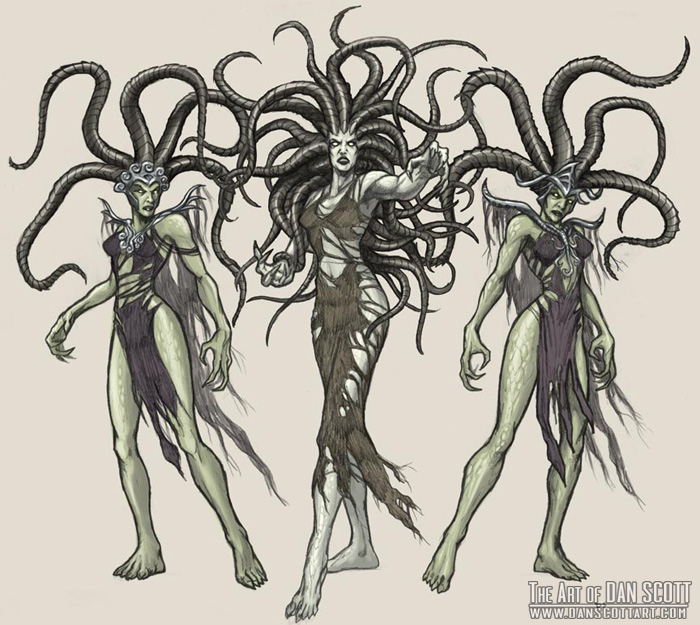
When you're using an archetypal character, it helps to be able to see as big a picture of that character as possible. To go back to Medusa, it wasn't enough to simply see her as a monster with snakes on her head. I needed to know the myth inside and out. That's how I discovered that she was created by Athena for fooling around with Poseidon in Athena's temple. But that still wasn't enough, so I went back to the Gorgons. Why make her a Gorgon? They were protectors, meant to inspire terror in the enemies of the Olympians. In fact, Zeus put the aspect of the Gorgon on his shield, using the image of a power older than Classical Greece to reinforce his own power.
Older than Greek? Okay. I looked up ancient snake goddesses and snake symbolism. Ladon the serpent protected the golden apples of the Hesperides. Blood taken from Medusa's right side was made into a healing potion by Aesclepius. A snake is wound into a symbol of healing in the Rod of Aesclepius. Moses formed a copper snake and twined it around a pole to heal the Israelites. Snakes were regarded as wise and cunning and could even gift people with second sight. Wisdom? Healing? Protection? The worship of a chthonic (earth-based) serpent deity had as many positive notes as it did negative.
So when you look to archetypes and ancient tales to build a story, be sure to cast your net wide. You'll pull in more than you dreamed!
16 April 2010
Back to Work
Literally, in my case.
I've been a SAHM for 13 years. That's what happens when you marry the Air Force. It's not exactly conducive to most two-career families, so I happily left my job as a ticket agent at Delta Airlines and moved away for a life of high excitement, two children, and a lot of packing and unpacking. I started to write about half-way through this grand adventure, so I did have my career -- it was just at home, and I fit it in around my family's needs.
As long as my children have been in school, I've been volunteering in school libraries, whether they wanted me to or not. I can't plan parties and I'm not responsible enough to be a room mom. I'm not even a very good classroom assistant. But I shine in a library. I love them. The order, discussing the merits of Judy Moody over The Magic Treehouse, talking about fairy tales with middle school kids...I just love school libraries.
So about a month ago, I was doing my thing at school when the librarian pops up and says, "You know, they're looking for an actual library assistant at Such-N-Such School. You should apply."
In fact, since I happened to be volunteering at two libraries that day, when I mentioned it at the other one, the librarian said, "Oh yeah! You'd be great at that!"
So I did. I applied. And they called for an interview. So I went on my first interview in 13 years. Then they hired me. So I got my TB test and got fingerprinted and Wednesday was my first day of work. In 13 years.
I'm now a temporary, part-time library assistant at a high school. I'm around people all day. In some ways, it's like being a mom of toddlers again. As soon as I sit down to do one project, someone calls out and asks me to do something else instead. I started five projects yesterday and between all of us, four were accomplished, but not always finished by the person who started them.
I'm the youngest person there. Everyone else's kids are grown and gone, and some of my coworkers are grandmothers now.
But the best part? Is looking through all the books. It's a really large library and very current. There are books I've only heard of, but never seen. Books I've been wanting to read for ages. And it's a comfort to see old favorites there, too. Nora is on the shelf! And Jude Devereaux!
In any case, I'm officially a working mom now. At least until the end of the school year. And while it's very different from my previous routine, I find myself enjoying it.
Well, off to my 3rd day at work. Wish me luck!
I've been a SAHM for 13 years. That's what happens when you marry the Air Force. It's not exactly conducive to most two-career families, so I happily left my job as a ticket agent at Delta Airlines and moved away for a life of high excitement, two children, and a lot of packing and unpacking. I started to write about half-way through this grand adventure, so I did have my career -- it was just at home, and I fit it in around my family's needs.
As long as my children have been in school, I've been volunteering in school libraries, whether they wanted me to or not. I can't plan parties and I'm not responsible enough to be a room mom. I'm not even a very good classroom assistant. But I shine in a library. I love them. The order, discussing the merits of Judy Moody over The Magic Treehouse, talking about fairy tales with middle school kids...I just love school libraries.
So about a month ago, I was doing my thing at school when the librarian pops up and says, "You know, they're looking for an actual library assistant at Such-N-Such School. You should apply."
In fact, since I happened to be volunteering at two libraries that day, when I mentioned it at the other one, the librarian said, "Oh yeah! You'd be great at that!"
So I did. I applied. And they called for an interview. So I went on my first interview in 13 years. Then they hired me. So I got my TB test and got fingerprinted and Wednesday was my first day of work. In 13 years.
I'm now a temporary, part-time library assistant at a high school. I'm around people all day. In some ways, it's like being a mom of toddlers again. As soon as I sit down to do one project, someone calls out and asks me to do something else instead. I started five projects yesterday and between all of us, four were accomplished, but not always finished by the person who started them.
I'm the youngest person there. Everyone else's kids are grown and gone, and some of my coworkers are grandmothers now.
But the best part? Is looking through all the books. It's a really large library and very current. There are books I've only heard of, but never seen. Books I've been wanting to read for ages. And it's a comfort to see old favorites there, too. Nora is on the shelf! And Jude Devereaux!
In any case, I'm officially a working mom now. At least until the end of the school year. And while it's very different from my previous routine, I find myself enjoying it.
Well, off to my 3rd day at work. Wish me luck!
19 March 2010
Where Have All the Punks Gone?

The closing of CBCG signaled the end of an era for the modern punk. In a bitter irony, the old club space has been taken over by men’s fashion designer John Varvatos. Ouch.
But the spirit of the punk lives on, and not just in music. Punk was always about people making their own way, not depending on anyone to do it for them, and a rejection of the commercial. Sometimes that freedom expressed itself in violent, self-destructively anarchic ways, but some of the art and attitudes that sprang from the movement were also mind-blowingly inventive, displaying the DIY ethic that ran deep in Punk's veins.
Two current trends in genre fiction use the ‘punk’ suffix, but they couldn’t be further away from each other in many ways.
Cyberpunk hit the books long before Steampunk, so we’ll start there.
Cyberpunk is dark. There’s no getting around it. It’s the way the Punks of the 20th century – marginalized, alienated, dismissed and rejected – viewed the future. A future often run by corporations, rather than democratically elected governments. A future where we were in the final stages of killing off the Earth, where technology was power.
There’s no beautiful utopian vision of peace and prosperity in cyberpunk, where everyone is equal and no one needs money to get what they need.
No. Cyberpunk is deeply and insidiously dystopian. A future that is grim and gray and violent, ruled by rapacious greed. The protagonists of cyberpunk stories written by Philip K. Dick or William Gibson aren’t what we usually call “heroic” in romance terms, and the endings are rarely happy.
The unfortunately short-lived Shomi line from
Steampunk, on the other hand, got its name from a play on words by author K.W. Jeter, who thought the Victorian fantasies that he and a few others were writing should have a name that focused on the use of technology, much as cyberpunk focused on it. Hence, the term “Steampunk” was born.
Right off the bat, it’s easy to see that many of the Punk attitudes and philosophies that inspired Cyberpunk weren’t truly evident in its historical counterpart.
And yet… and yet… The Victorian-inspired fantasies and science fiction often make commentary on history’s politics and policies. Slavery, imperialism, the power of the haves over the have-nots, religious, cultural and sexual attitudes are all touched on in Steampunk.
Putting a heroine in a bustle doesn’t make a story Steampunk any more than dressing a hero in a long leather duster makes him a Cyberpunk Neo.
The punk in both movements is deeply embedded in the world that writers build. The Punk ethos of tinkering and DIY is inherent in the way that Victorian technology progressed.
I think where the two sets diverge is primarily in their view of what comes next. The Victorians in general looked forward to a future of great technological advancement and upward mobility of all socio-economic classes, so their “futuristic” fiction was largely optimistic, much in the way that many of our current non-Punk futuristic writers envision the time to come. Not all fluffy bunnies and cotton candy clouds, of course, but a future in which we’re making our world better. Steampunk, then, is more readily optimistic, despite some of the grim literary offerings from William Gibson and others.
Steampunk literature also often tends to branch into the fantastic more easily than Cyberpunk. Victorian science wasn’t strictly opposed to the idea of alchemy or occultism, so adding magical elements to the technology of the day is less far-fetched than might otherwise be thought. After all, Clarke’s 3rd law states “Any sufficiently advanced technology is indistinguishable from magic.”
It’s my personal view that Steampunk is most moving, though, when it’s set in a fully realized world that has the same problems that the protagonists in Cyberpunk face. Political and commercial greed, abuse of power, marginalization of segments of society – problems that are sadly eternal, part of the human condition. When we face those issues, even in our feel-good literature, we can move people to forward progress.
The Ramones are dead, CBCG is gone, but the things that made Punk so powerful live on.
19 February 2010
Serenity Now

Today, y’all get the confluence of a few things that have been flowing in my life that aren’t necessarily about writing, certainly aren’t paranormal, but they do influence my writing.
First, what genius thought up perimenopause? Because this betwixt and between stage is like the hell-end of purgatory and I can see the fire and brimstone from here.
*Deep breaths. Serenity now.*
I sometimes wish I was more crunchy granola with the whole maiden/mother/crone, moving through life stages, welcoming a change in fertility, yadda yadda yadda. This is a freaking nightmare. I can’t think and the mood swings should come with a warning claxon that screams, “Step away from your mother! Maintain peace at all costs! Go to your room if you value your life!”
*More deep breaths. Serenity now, please.*
Second, ADD can be kind of fun. Things that were lost become new again when found. This is not actually so when the lost thing is a bill.
*Whoo. Getting light headed. And was I not asking for serenity loudly enough?*
The mood swings are killing my writing, too. I am currently on my fifth version of this @#$*& Steampunk story. It’s not enough, apparently, that even though I started it four years ago it now looks like I’m just jumping on the bandwagon. No. Now I realize that because I have no magical or paranormal elements to it, I’m actually writing science fiction – and I swore I’d never write science fiction because the worldbuilding and the details are an absolute killer. Welcome to my fictional nightmare.
*Screw the deep breathing. Where the hell is my serenity?*
So. Wildly fluctuating hormone levels, wonky brain chemistry, and worldbuilding that is sapping my will to live. I haven’t decided whether to go Virginia Woolf or Mad Max with this little crossroads of life. But you know what I do want?
SERENITY NOW!!!!!
25 December 2009
I know not everyone here belongs to the same faith, but I do believe that we all strive toward a common goal and so, at this season where we celebrate the birth of One who came to give us life, I wish you all a very merry Christmas.
And there were in the same country shepherds abiding in the field, keeping watch over their flock by night.
And, lo, the angel of the Lord came upon them, and the glory of the Lord shone round about them: and they were sore afraid.
And the angel said unto them, Fear not: for, behold, I bring you good tidings of great joy, which shall be to all people.
For unto you is born this day in the city of David a Saviour, which is Christ the Lord.
And this shall be a sign unto you; Ye shall find the Babe wrapped in swaddling clothes, lying in a manger.
And suddenly there was with the angel a multitude of the heavenly host praising God, and saying,
Glory to God in the highest, and

Sela Carsen
www.selacarsen.com
And there were in the same country shepherds abiding in the field, keeping watch over their flock by night.
And, lo, the angel of the Lord came upon them, and the glory of the Lord shone round about them: and they were sore afraid.
And the angel said unto them, Fear not: for, behold, I bring you good tidings of great joy, which shall be to all people.
For unto you is born this day in the city of David a Saviour, which is Christ the Lord.
And this shall be a sign unto you; Ye shall find the Babe wrapped in swaddling clothes, lying in a manger.
And suddenly there was with the angel a multitude of the heavenly host praising God, and saying,
Glory to God in the highest, and
on earth peace, good will toward men.

Sela Carsen
www.selacarsen.com
01 December 2009
 Isn’t it gorgeous? The Tickle My Fantasy anthology is out in print today!!
 Go ahead. Try to resist the magic. We dare you!
Carolina Wolf by Sela Carsen (psst! This is me!)
Debra knows that the teensy amount of witchcraft in her veins isn’t worth getting excited about. Yet someone—or something—thinks it’s worth attacking her. Rescuing her seals Maddox’s fate, but only if he can protect her from a rogue of his kind. A werewolf with a nasty streak…and a preference for raw meat.
The Ghost Shrink, the Accidental Gigolo and the Poltergeist Accountant by Vivi Andrews
Lucy is doomed. Not to death. To nightly visits from recently deceased Casanovas without the bodies to scratch her itch. Then a living fantasy arrives on her doorstep. Is her dry spell at an end? Not hardly. Jake has been sent to prevent her from getting laid until a particular horny phantom—and key witness in his investigation—pays her a visit.
ParaMatch.com by MK Mancos (hi Kat!)
Even though she lives without a paranormalady, Lucille has managed to carve a niche for herself with a paranormal matchmaking service. Enter Jager, deposed king of the Titans and successful paratrader. She can match anyone, except him. She doesn’t know that he’s out to negotiate the deal of a lifetime—a future with her.
Witches Anonymous by Misty Evans
Amy is done with Devil-worshipping. After swearing an oath never to use magic again, she’s in the market for a normal guy to complement her new lifestyle. And Adam looks like perfect hero material. Lucifer, however, isn’t about to be nice about letting her go…
Warning: This book contains hunky werewolves, smart-ass women and men who think that’s sexy, magic, angels, medieval legends, inter-species romance, disco music and flatulent Boxers. (The dogs, not the underwear.)
Read An Excerpt Online
30 October 2009
The Second Time Around
I’m writing a … what do you call a second story in the same world? Is that a series? Is it a sequel? Because it’s not about the same couple, so ‘sequel’ seems like the wrong word. Anyway, I’m writing a second story. It’s hard because I’m not naturally set up to write series. Once I put a story to bed, that’s it. I’m ready to move on to something else. Maybe it’s a product of my gypsy upbringing. After two years in one place, I’m usually ready for the movers to show up. Time to go see something new.
Unfortunately, my gypsy days are at an end. I live in the Midwest now. In the burbs, no less. I’ve been here for three years and will be for the foreseeable future. Good schools, nice neighborhood, pool, sidewalks, all that American Dream stuff. Writing is the only thing that’s keeping me from drinking in the afternoon.
It’s an apt metaphor for my writing, though. Suddenly, I’m compelled – by forces outside myself, I might add – to write this story that’s set back in Culford, SC. Back in the Congaree Swamp.
I spend a lot of time on my settings. I know where my stories live. I’ve said before that if this place was real, I could walk through it blindfolded and know just where I was at every step. Culford is a great setting. I loved writing that little town.
But I’m having a difficult time with it this time around. Writing new stories in new settings is fun and exciting. Writing a new story in an old setting means that suddenly I have to work much harder to make things interesting for myself.
I worry that the secondary characters I loved in one story will seem saccharine the next time around. I worry that familiarity will breed contempt for all the things that were so charming the first time.
However, this is the hand I’ve been dealt. And much like my current status as a Midwestern suburban hausfrau, I’m going to make the best of it. I just have to dig a little deeper into my setting and my characters to make them feel comfortable, rather than merely worn.
And next time I sign up to write a sequel, shoot me.
02 October 2009
Bestiary 201: Composite Beasts
For today’s bestiary lesson, we’re going to talk about a few composite creatures – those that seem to be made of the leftovers of Creation.
 First, the Manticore. The Manticore is made of three elements. It has the face of a man, the blood-red body of a lion, and the tail of a scorpion. It’s from India and feasts on the flesh of men with its rows of sharp teeth. Its voice is that of pipes, or pipes blended with trumpets – somewhat incongruous for such a terrifying beast.

The Manticore, because of its human face, is often related to the Sphinx, even going so far as to make its prey answer riddles. Spiritually, it represents fraud because its face hides its true nature.
 The Leucrota is another impossible combination made from the offspring of a hyena and a lioness. Now, through countless National Geographic Specials, lots of Animal Planet and, of course, “The Lion King,” we know that lions and hyenas do NOT get along, so unless there’s some kind of interspecies Romeo and Juliet thing that happened along the way, plus a good dose of miraculous genetic coding, this particular beast never existed.
Pliny the Elder went even further than hyena/lion in his description: “The leucrocota is the size of an ass, and has the neck, tail and breast of a lion, the haunches of a stag, cloven hooves, a badger's head, and a mouth that opens from ear to ear, with ridges of bone instead of teeth. It is the swiftest of wild animals, and is said to be able to imitate the human voice.”
The next two aren’t so much composite creatures in description, as much as they’re shown that way in illustration.

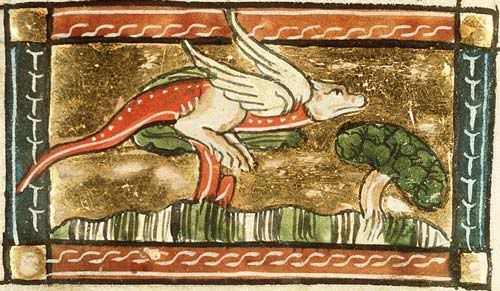
The Jaculus is a flying serpent often depicted with a serpent’s body, but the wings of a bird and the haunches of a beast. It waits in trees for prey to pass beneath, then jumps down and kills it.
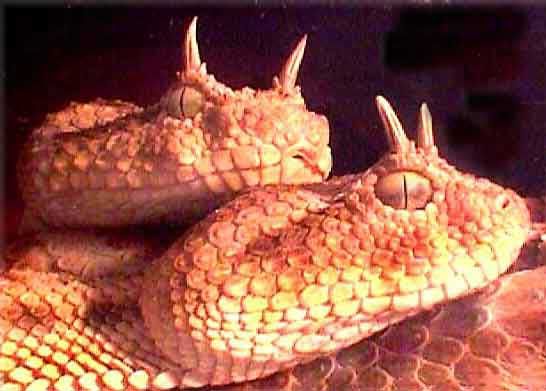
 The Cerastes is very likely a Horned Viper, which is a real snake that lives in the Sahara Desert. The medieval illustration, however, depicts a serpent with the literal head of a horned ram.

My bestiary story has been moved back in my writing queue, so there’s no guarantee on what I’ll be talking about next time I blog. I may continue in this vein, I may go back to pantheons of gods – you just never know, so stay tuned!
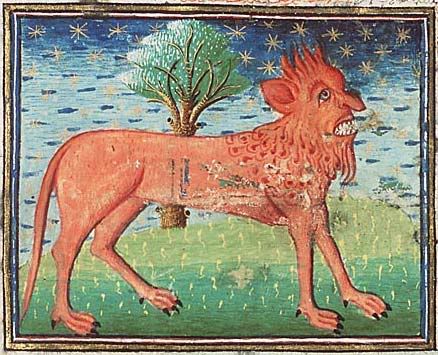 First, the Manticore. The Manticore is made of three elements. It has the face of a man, the blood-red body of a lion, and the tail of a scorpion. It’s from India and feasts on the flesh of men with its rows of sharp teeth. Its voice is that of pipes, or pipes blended with trumpets – somewhat incongruous for such a terrifying beast.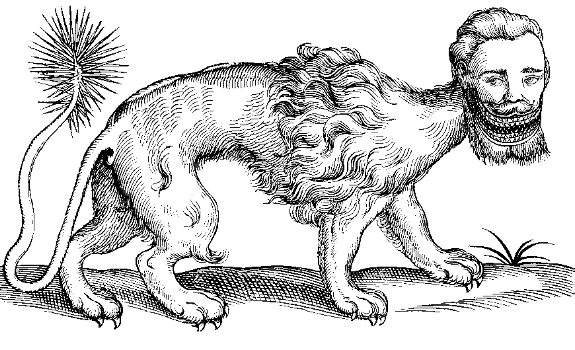
The Manticore, because of its human face, is often related to the Sphinx, even going so far as to make its prey answer riddles. Spiritually, it represents fraud because its face hides its true nature.
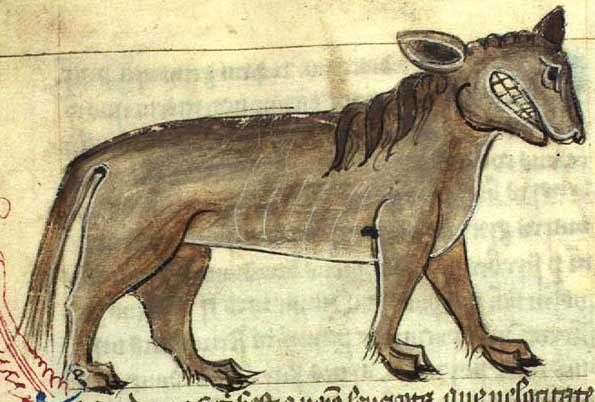 The Leucrota is another impossible combination made from the offspring of a hyena and a lioness. Now, through countless National Geographic Specials, lots of Animal Planet and, of course, “The Lion King,” we know that lions and hyenas do NOT get along, so unless there’s some kind of interspecies Romeo and Juliet thing that happened along the way, plus a good dose of miraculous genetic coding, this particular beast never existed.
Pliny the Elder went even further than hyena/lion in his description: “The leucrocota is the size of an ass, and has the neck, tail and breast of a lion, the haunches of a stag, cloven hooves, a badger's head, and a mouth that opens from ear to ear, with ridges of bone instead of teeth. It is the swiftest of wild animals, and is said to be able to imitate the human voice.”
The next two aren’t so much composite creatures in description, as much as they’re shown that way in illustration.
The Jaculus is a flying serpent often depicted with a serpent’s body, but the wings of a bird and the haunches of a beast. It waits in trees for prey to pass beneath, then jumps down and kills it.
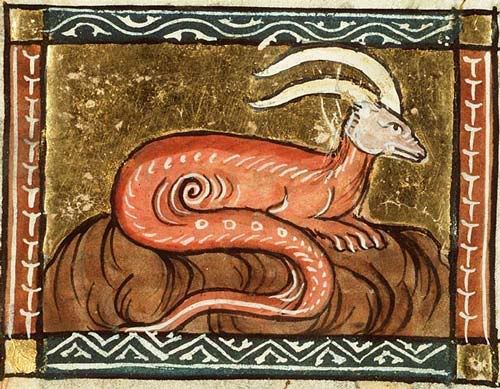 The Cerastes is very likely a Horned Viper, which is a real snake that lives in the Sahara Desert. The medieval illustration, however, depicts a serpent with the literal head of a horned ram.
My bestiary story has been moved back in my writing queue, so there’s no guarantee on what I’ll be talking about next time I blog. I may continue in this vein, I may go back to pantheons of gods – you just never know, so stay tuned!
04 September 2009
Bestiary 102
We're back for another round of fantastic beasts!
First, I'd just like to thank the universe for the wonder known as Inter Library Loan. My library system didn't own a copy of T.H. White's Book of Beasts, so I was able to borrow a copy all the way from the University of Wisconsin! I can't tell you what a happy library geek I am. :)
Today's information will all come from that source as I only have it on loan until next week.
Bestiaries are often divided into sections of beasts, birds and reptiles/amphibians. As I mentioned last time, many of the beasts that are catalogued are real creatures, even if their allegorical traits are a spiritual stretch.
The unicorn is described as being the size of a goat, and may be trapped by a virgin. There's one thing that has always puzzled me about that, though. If a unicorn is a creature of purity and innocence and goodness, and the girl is a willing accomplice in trapping this creature, then how on earth does her physical state of being trump her basic greed and evil? Because you'd have to be a pretty slimy specimen to want to kill a unicorn. You'd think that a mythic beast attracted those wholesome traits would be able to smell the evil intent a mile away.
Oh well, there's a mystery for the ages.
One of the charming things about White's translation are his footnotes. They crack me up. Under the entry for the Griffin, he first quotes Lewis Carroll from Alice in Wonderland: "If you don't know what a Griffin is, look at the picture." He then goes on to theorize that the Griffin has no basis in a real creature, but is an animal of fantasy. He illustrates with a Victorian poem about a mythical Dodo (not the one we know is extinct), but ends with the following statement: "The Griffin, however, was a serious animal.... It does not pay to be supercilious about the creatures in a Bestiary."
Yes, sir.
The section on birds is largely based on real animals with a couple of notable exceptions. First, the Caladrius -- a white bird that could foretell death. If it was shown to a patient who would survive, the bird would face the patient. If, however, it prophesied death, it would turn its head away. Again, White's footnotes add to the story with a uniquely human point of view.
It would be difficult to actually sell a Caladrius to anyone, he writes, because the buyer (presumably the victim of the illness) merely needed to enter the store on the pretense of purchasing the bird, have it look at him and tell his future, then leave the store without actually exchanging cash for the prophecy. White tells us that birdsellers became canny and refused to show the bird unless there was cash in hand.
Typical humans.
The Fenix (sic) is a familiar beast to many of us. The allegory to the risen Christ is unmistakable. It foretells its own death, makes arrangements -- builds a sweet smelling nest/funeral pyre of cinnamon and spice branches, then sets itself on fire. "Then verily, on the ninth day afterward, it rises from its own ashes!" The bestiary mentions another creature which may simply be the Phoenix by another name -- the Cinomolgus. And again, White gives us more information by mentioning the Emperor Heliogabulus (3rd century) who was a "glutton and debauchee." He decided that he wanted to eat a Cinomolgus/Phoenix so that he could take in its longevity and probably its ability to rise from the dead. Some poor rare bird or another was obtained for him, he immediately set fire to it and ate it. "One is thankful to know that he was murdered very shortly afterwards." And presumably, didn't come back.
There are hundreds of creatures listed in White's translation -- many are ordinary creatures exalted to an uncomfortable place in medieval symbolism, but the extraordinary few do set fire to the imagination. More next time!
First, I'd just like to thank the universe for the wonder known as Inter Library Loan. My library system didn't own a copy of T.H. White's Book of Beasts, so I was able to borrow a copy all the way from the University of Wisconsin! I can't tell you what a happy library geek I am. :)
Today's information will all come from that source as I only have it on loan until next week.
Bestiaries are often divided into sections of beasts, birds and reptiles/amphibians. As I mentioned last time, many of the beasts that are catalogued are real creatures, even if their allegorical traits are a spiritual stretch.
The unicorn is described as being the size of a goat, and may be trapped by a virgin. There's one thing that has always puzzled me about that, though. If a unicorn is a creature of purity and innocence and goodness, and the girl is a willing accomplice in trapping this creature, then how on earth does her physical state of being trump her basic greed and evil? Because you'd have to be a pretty slimy specimen to want to kill a unicorn. You'd think that a mythic beast attracted those wholesome traits would be able to smell the evil intent a mile away.
Oh well, there's a mystery for the ages.
One of the charming things about White's translation are his footnotes. They crack me up. Under the entry for the Griffin, he first quotes Lewis Carroll from Alice in Wonderland: "If you don't know what a Griffin is, look at the picture." He then goes on to theorize that the Griffin has no basis in a real creature, but is an animal of fantasy. He illustrates with a Victorian poem about a mythical Dodo (not the one we know is extinct), but ends with the following statement: "The Griffin, however, was a serious animal.... It does not pay to be supercilious about the creatures in a Bestiary."
Yes, sir.
The section on birds is largely based on real animals with a couple of notable exceptions. First, the Caladrius -- a white bird that could foretell death. If it was shown to a patient who would survive, the bird would face the patient. If, however, it prophesied death, it would turn its head away. Again, White's footnotes add to the story with a uniquely human point of view.
It would be difficult to actually sell a Caladrius to anyone, he writes, because the buyer (presumably the victim of the illness) merely needed to enter the store on the pretense of purchasing the bird, have it look at him and tell his future, then leave the store without actually exchanging cash for the prophecy. White tells us that birdsellers became canny and refused to show the bird unless there was cash in hand.
Typical humans.
The Fenix (sic) is a familiar beast to many of us. The allegory to the risen Christ is unmistakable. It foretells its own death, makes arrangements -- builds a sweet smelling nest/funeral pyre of cinnamon and spice branches, then sets itself on fire. "Then verily, on the ninth day afterward, it rises from its own ashes!" The bestiary mentions another creature which may simply be the Phoenix by another name -- the Cinomolgus. And again, White gives us more information by mentioning the Emperor Heliogabulus (3rd century) who was a "glutton and debauchee." He decided that he wanted to eat a Cinomolgus/Phoenix so that he could take in its longevity and probably its ability to rise from the dead. Some poor rare bird or another was obtained for him, he immediately set fire to it and ate it. "One is thankful to know that he was murdered very shortly afterwards." And presumably, didn't come back.
There are hundreds of creatures listed in White's translation -- many are ordinary creatures exalted to an uncomfortable place in medieval symbolism, but the extraordinary few do set fire to the imagination. More next time!
07 August 2009
Bestiary 101
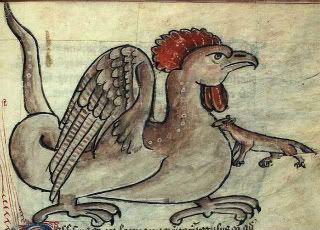
Do you know the difference between a cockatrice and a basilisk?
Ever heard of a Leocrota? Or an Anphivena?
Well, today is your first day of Bestiary 101.
Dude. Not bestiality. That’s just gross. Get your mind out of the gutter.
A bestiary is just an encyclopedic list of animals, but in antiquity, let’s just say that there wasn’t much emphasis placed on scientific method. But the true purpose of a bestiary wasn’t exactly scientific. Each animal was examined as an illustration of God’s creation and its habits were moralized to teach Christian doctrine. They were used as allegorical illustrations to teach the mysteries of divinity.
The first bestiary in evidence was called the Physiologus, written in Greek, probably around the 2nd to 4th century AD (sources vary). The author of this work drew from numerous sources around the world – “Indian, Hebrew and Egyptian animal lore and various classical natural philosophers like Aristotle and Pliny.” (1)
In the 7th century, a Spanish clergyman named Isidore of Seville (2) wrote another work called the Etymologiae which added to the ground that the original Physiologus covered. He also organized them more efficiently.
Around the 12th century, those two seminal works, plus a few others, combined to make the Bestiary as we understand it today.
Beautifully illustrated, the pictures are frequently inaccurate, even when it comes to creatures we know today. How many English monks had ever really seen a crocodile? They could only draw what they understood from the texts, so it’s hardly a surprise to see a crocodile rendered as a long, dog-shaped beast, or a whale depicted as an oversized, scaly fish.
The illustrations served the purpose of providing a visual lesson to the largely illiterate peasantry as the priest gave a homily on the nature of the divine as found in a pelican or a lion. Sometimes they were also used as simple morality tales. Reynard the Fox (3), the trickster of the Middle Ages, often teaches a lesson.
As this is merely an introduction to a new series of articles, I’ll leave you with some general links to different bestiaries:
The Aberdeen Bestiary
The Ashmole Bestiary
The Harley Bestiary
The Northumberland Bestiary
T.H. White, the English scholar who wrote “The Once and Future King” and other Arthurian tales, also gave us the first English translation of a medieval Bestiary in his book “The Bestiary: A Book of Beasts.”
Next month, we’ll begin our search for some fantastic creatures and the stories behind them.
1. Aberdeen Bestiary Project
2. The Medieval Bestiary
3. The History of Reynard the Fox, ed. Henry Morley
BTW, a basilisk and a cockatrice are the same thing!
03 June 2009
Selkies and other water shifters
I recently sold a novella (my first standalone novella) to Samhain. The heroine is a selkie. So I got curious to see what other selkies or ocean-creature shifters had been published by Samhain. I figured there would be a few and found six. In no particular order, I'm going to list them, and if I miss any let me know!
I'm giving some teasers from the blurbs. There look to be some interesting reads of all different sorts. I love to see different takes on this. Books 5 and 6 are coming soon, by the way, and not yet released, though I think they'll be great summer reads. (Mine's not out till August, and it's entitled Selkie Island.)
ETA: Added #7
I'm giving some teasers from the blurbs. There look to be some interesting reads of all different sorts. I love to see different takes on this. Books 5 and 6 are coming soon, by the way, and not yet released, though I think they'll be great summer reads. (Mine's not out till August, and it's entitled Selkie Island.)
ETA: Added #7
- In the Shadow of the Selkie by M.A. duBarry
In the dangerous world of the selkie underground, a selkie vampire king and a mortal woman join forces to fight the queen of darkness that would destroy them all.
- Heart of the Sea by Sela Carsen
Can the promise of true love overcome a bitter Selkie curse? Ronan Burbank once had it all. Wealth, privilege, a thriving company. But one tragedy turned everything he touched to ash. Meriel Byrne’s life was fairytale perfect until the day she fell into the sea off the Rhode Island coast.
- Sealed With a Kiss by Lila Dubois
When a man who isn’t human is accidentally enslaved by a woman who has no idea what he is, the result is magical. Signing up for a one-week adventure vacation, Helena expects to be kayaking in the Pacific, not having every sexual fantasy fulfilled in her guide’s bed. Ocean is more than he seems, his kayaking business a cover for his deepest secret.
- The Ocean's Shadow by Jennah Sharpe
Storms erupt when a merman’s treasure is stolen from him. A dark, shadowy creature haunts the waters of Copperberry’s rugged coast. Feared by the villagers, he incites lust in the lonely women of the town. A servant, escaped from abusive employers, Claire never expected to live through the storm she threw herself into.
- Lycan Tides by Renee Wildes
Selkie princess Finora is all too familiar with betrayal. Betrayal by her curiosity, which led her from the sea. By her body, which yielded to a handsome human under the full moon. By the human, who hid her skin and took its location with him to his grave.
- Tidal Wave by Vivian Arend
After she’s gifted with a beautiful, dolphin-etched medallion, she finds herself surrounded by the golden boys of summers past. Her body is filled with longings she can’t explain and dreams of blue lights that turn into lovers. Joshua Marley and his cousin Anthony are merfolk, a people capable of living beneath the waves as either dolphin or human.
- Abhainn's Kiss by Carolan Ivey
Hidden away on a misty island off the Irish coast all her life, Abhainn has no idea she is the last of her Faery race—until a troll tries to kill her. Her peaceful world shattered, she has only days to fulfill her destiny. She must defy a curse that dooms her to hide from the sun, and take her rightful place in the Great Circle on the Isle of Avalon.
15 May 2009
Gorgons

Snake haired, fanged furies of Greek myth. Popular mythology concentrates on Medusa, but there’s much more to these ladies than we learn from monster movies.
In fact, there’s some doubt as to whether there are one or three of them. And if there are three, why are two immortal (Sthenno and Euryale) and poor Medusa the only mortal?
The tales of one Gorgo come from the oldest myths, told by the poet Homer. The head of the Gorgo was taken to form the aegis of the shield of Athena. Even Euripides believed in only one monster. It’s Hesiod who transformed the tale to include three sisters, the daughters of Phorkys and Keta. He portrayed them with snakes and fangs, but Aeschylus gave them wings.
The early Classical poets agreed on one thing. The Gorgons were horrible to observe. Some of the images were incredibly creepy. It wasn’t until the later Classical period that poets and artists humanized Medusa from a monster to a beautiful, but cursed woman.

So back to my original question. How do you end up with two out of three immortal daughters? Wicked bad luck, is what I’m thinking.
Mortal Medusa was a beauty, the stories say. Some believe that she compared her beauty to that of Athena. We’ve already seen how that works out. *cough*Arachne*cough* But others feel that her fate can be laid at the feet of another god. One who wouldn’t take no for an answer. Medusa was a servant of Athena, but the great sea god Poseidon was enchanted by her beauty, so he seduced her in Athena’s temple. The virgin goddess turned her eyes away in horror, then punished Medusa by turning her lovely hair to snakes.
WTH?!? Girl has sex, so you turn her into a monster? Wow. That’s some seriously messed up logic (as well as a seriously uptight and repressed goddess), but Medusa’s tragedy doesn’t end there.
Now she’s even more super special than just being the gorgeous daughter of gods. No. Now she can turn men to stone with a glance because they’re so filled with dread at her hideous appearance.
See, now she’s a weapon, and we know how gods and warriors and heroes get all excited about new weapons. King Polydektes had challenged Perseus to bring him the head of the Gorgon, so he set off on his heroic quest, aided by Hermes, Athena (traitor!) and Hades.
The Graiaie guarded the cave where the Gorgons slept, but they had only one eye between them. Perseus stole the eye and bargained it for entrance to the cave. He used the reflection of his polished shield to find Medusa and cut off her head with one stroke.
However, in her death, Medusa gave birth to new life. The winged horse Pegasus and the giant Khrysaor sprang from her death-wound.
Perseus then brought her head back to his enemies, flying over Libya to get home. As he flew, drops of the Gorgon’s blood fell to the sand, creating fatally poisonous vipers in the desert there.
Medusa’s head was used to vanquish armies as well as the odious Polydektes, then turned over to Athena as the centerpiece for her aegis.
The End. *sniffle* She picked the wrong guy and died for it. No HEA for our girl Medusa.
But...could there be? I’ll let you know when I finish writing my current story, inspired by Medusa’s tale.
Subscribe to:
Posts (Atom)